We research products independently. When you buy through links on this page, we may earn a commission from Amazon at no extra cost to you. As an Amazon Associate we earn from qualifying purchases. Read our affiliate disclosure.
A laser projector replaces the old lamp with a solid-state light source rated for tens of thousands of hours. There's no bulb to change, no slow warm-up and far less brightness loss in the first few years. If you plan to use a projector as your main screen, that's the upgrade that matters most.
Lasers aren't all the same, though. What matters when you choose is the type of laser (phosphor or RGB triple laser), the brightness your room needs, the throw distance you have, and whether you need streaming built in or will add your own box. Below are six laser projectors, from a very bright 4K triple laser to a long-life 1080p model. For more options at that resolution, see our Full HD projector guide.
Our top picks at a glance


Quick picks
- Best Overall: XGIMI Horizon 20 MaxBest for a bright 4K picture with lens shift and Google TV.
- Best for Dark Theaters: Epson Home Cinema LS11000Best for a dedicated room with a long throw.
- Best Portable Laser: Hisense C2 ProBest for a 4K laser you can move between rooms.
- Best for Gaming: BenQ TK710Best for low input lag at 1080p and 240Hz.
- Best Long-Life Value: Optoma UHZ66Best for the longest rated light source here, 30,000 hours.
- Best 1080p Laser: ViewSonic LS740HDBest for high brightness when 4K isn't the priority.
Comparison table
| Projector | Best for | Resolution | Brightness (maker's rating) | Laser type | Rated light life | Throw ratio | Amazon |
|---|---|---|---|---|---|---|---|
| XGIMI Horizon 20 Max | Overall | 4K (pixel shift) | 5,700 ISO lumens | RGB triple laser | Not stated | 1.2–1.5 | Check price |
| Epson LS11000 | Dark theaters | 4K PRO-UHD (pixel shift) | 2,500 lumens color/white | Laser, 3LCD | 20,000 hours | 1.35–2.84 | Check price |
| Hisense C2 Pro | Portable laser | 4K UHD | 2,600 lumens | RGB triple laser | 25,000 hours | 0.9–1.5 | Check price |
| BenQ TK710 | Gaming | 4K (pixel shift) | 3,200 ANSI lumens | Laser phosphor | 20,000 hours | 1.15–1.5 | Check price |
| Optoma UHZ66 | Long life | 4K UHD | 4,000 ANSI lumens | Laser phosphor | 30,000 hours | 1.4–2.24 | See options |
| ViewSonic LS740HD | 1080p laser | 1080p | 5,000 ANSI lumens | Laser phosphor | 20,000 hours | 1.13–1.47 | Check price |


Brightness ratings use different standards (ISO, ANSI and Epson's color and white figures), so read them as tiers rather than exact comparisons.
The best laser projectors, reviewed
1. XGIMI Horizon 20 Max: Best Overall
Who it's for: living rooms and media rooms that want a very bright 4K picture without building a dedicated theater.
The Horizon 20 Max is the brightest home-style pick here, with XGIMI rating it at 5,700 ISO lumens from an RGB triple laser. ProjectorCentral's review measured 5,342 ANSI lumens in the brightest mode, about 6% under the rating, which is a respectable result for this class. It's a 3840 x 2160 picture from a 0.47-inch DMD chip using pixel shifting.
The hardware is what sets it apart from most lifestyle projectors. You get optical zoom and real lens shift, listed at ±120% vertical and ±45% horizontal, so you can place it off-center and keep the image square without digital correction. Throw is 1.2 to 1.5:1, which puts a 100-inch screen about 8.7 to 10.9 ft away. Google TV, Dolby Vision, HDR10+ and IMAX Enhanced are all listed, along with 1 ms latency at 1080p and 240Hz.
Pros
- 5,700 ISO lumens, confirmed close to rating by independent measurement
- Optical zoom and large lens shift range
- Google TV with licensed Netflix
- Dolby Vision and HDR10+
Cons
- Premium price tier
- Pixel shift rather than native 4K
- Rated light source life isn't published in the specs we found
2. Epson Home Cinema LS11000: Best for Dark Theaters
Who it's for: dedicated rooms where the projector can sit well back and contrast matters more than raw light output.
The LS11000 uses a 3-chip 3LCD design with Epson's 4K PRO-UHD pixel shifting and a laser source rated for 20,000 hours at full brightness. Epson rates it at 2,500 lumens of both color and white brightness, far below the XGIMI but plenty for a dark room. Because 3LCD has no color wheel, there's no rainbow effect for viewers who are sensitive to it.
The long 1.35 to 2.84:1 zoom is its big advantage in real rooms. A 100-inch screen can be filled from roughly 9.8 to 20.6 ft away, so it fits a rear shelf or ceiling mount in most theaters. Lens shift is generous too, at ±96.3% vertical and ±47.1% horizontal. Throw is long for a small room, so check your distance first.
Pros
- Very wide placement range from the 2.1x zoom
- Large lens shift
- 3LCD avoids rainbow artifacts
- 20,000-hour rated laser
Cons
- Lower brightness makes it a poor fit for lit rooms
- No smart platform for streaming apps in the listing
- Premium price tier
3. Hisense C2 Pro: Best Portable Laser
Who it's for: people who want a 4K laser but want to move it between the den, bedroom and backyard.
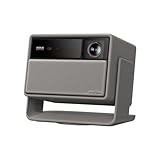
The C2 Pro is a compact RGB triple laser model with a 2,600-lumen rating, 3840 x 2160 resolution and a 25,000-hour rated light source. ProjectorCentral lists it with HDR10+ and Dolby Vision, and Hisense sells it with sound by JBL and its VIDAA smart platform. Hisense markets images from 65 to 300 inches.
Its powered 1.67x zoom covers a 0.9 to 1.5:1 throw, so a 100-inch picture lands anywhere from about 6.5 to 10.9 ft away. That's a useful range for a projector you'll set down in different rooms, and it means fewer compromises than the digital zoom most portables rely on. Weight is listed at 12.6 lb, so it's portable in the move-between-rooms sense rather than the carry-in-a-bag sense.
Pros
- 4K triple laser in a small body
- Wide 0.9–1.5 powered zoom
- Dolby Vision and HDR10+
- Built-in JBL sound
Cons
- VIDAA has a smaller app selection than Google TV
- 12.6 lb isn't truly pocketable
- Less bright than the Horizon 20 Max
4. BenQ TK710: Best for Gaming
Who it's for: console and PC players who want a responsive big screen.
The TK710 is a laser phosphor projector rated at 3,200 ANSI lumens with a 20,000-hour light source. ProjectorCentral lists input lag at 16.7 ms for 4K at 60Hz, 8.3 ms at 1080p and 120Hz, and 4.2 ms at 1080p and 240Hz, among the lowest figures published for this group.
Placement is simple: a 1.3x zoom gives a 1.15 to 1.5:1 throw, or about 8.4 to 10.9 ft for 100 inches, with a small +10% vertical lens shift. BenQ's listing includes HDR10 and eARC, but no built-in streaming platform, so plan on a streaming stick. If you want BenQ's closer-throw version, see our short throw projector guide.
Pros
- Very low input lag at 1080p and 240Hz
- Laser light source, 20,000 hours rated
- eARC for sending sound to a soundbar
Cons
- No built-in smart platform listed
- Pixel shift rather than native 4K
- Only a small amount of lens shift

5. Optoma UHZ66: Best Long-Life Value
Who it's for: heavy daily use, where light source life and a bright picture matter more than smart features.
Optoma's UHZ66 is rated at 4,000 ANSI lumens with a 30,000-hour laser, the longest rated life in this guide. It's a 3840 x 2160 DLP model with a 1.4 to 2.24:1 throw, so a 100-inch picture sits about 10.2 to 16.3 ft away, which suits a ceiling mount at the back of a room.
ProjectorCentral lists input lag down to 4.4 ms at 1080p and 240Hz and Full HD 3D support. There's no lens shift, so the projector has to sit in the right spot vertically or you'll rely on keystone correction, which softens the image. Its page lists a 1.6x zoom in the specs table but mentions 1.3x in its highlights, so confirm the throw range before you drill.
Pros
- 30,000-hour rated laser
- 4,000 ANSI lumens
- Low input lag at 1080p
- 3D support listed
Cons
- No lens shift
- Long throw is a poor fit for small rooms
- Sources disagree on the zoom range

Optoma UHZ66 4K Laser Projector
by Optoma
Currently unavailable on Amazon
6. ViewSonic LS740HD: Best 1080p Laser
Who it's for: bright rooms, classrooms and sports viewing where 4K isn't worth paying for.
The LS740HD trades resolution for output. ViewSonic rates it at 5,000 ANSI lumens (its US page advertises 5,500, which matches the center-brightness figure in the spec table), and ProjectorCentral's review measured 4,783 lumens in Bright mode. It's a 1920 x 1080 laser DLP rated for 20,000 hours, or 30,000 in SuperEco mode.
Throw is 1.13 to 1.47:1 with a 1.3x zoom, so roughly 8.2 to 10.7 ft for a 100-inch screen. It's built for installation, which means more setup tools and less home-theater polish. For a full comparison of bright options, see our high lumen projector guide.
Pros
- Highest ANSI rating here at 1080p
- Rated life up to 30,000 hours in SuperEco
- Budget-friendly compared with bright 4K models
Cons
- 1080p, not 4K
- Business-oriented picture and sound
- No smart platform

How to choose a laser projector
Laser phosphor or triple laser
A laser phosphor projector uses a blue laser and a phosphor wheel to create the other colors. It's a proven design with little visible speckle, and it's what the Epson, BenQ, Optoma and ViewSonic picks use. An RGB triple laser, used in the XGIMI and Hisense, has dedicated red, green and blue lasers and can reach a wider color range.
The catch with triple lasers is speckle, a faint shimmer some viewers notice on flat areas of color. It varies by screen and by viewer, and smooth, 4K-rated screens tend to show it less than textured ones. If you're sensitive to it, a phosphor model is the safer buy.
Brightness for your room
Screen size and room light decide how many lumens you need. A dark room needs far less than a living room with windows, and each step up in screen size spreads the same light over more area: a 120-inch screen has 44% more area than a 100-inch one.
Roughly, 2,000 to 3,000 lumens covers a dark room or light-controlled den at 100 to 120 inches. Four thousand and up starts to hold up with lights on. See the numbers worked out in our high lumen projector guide, then pair a bright projector with the right ALR projector screen if you can't control the light. For very large lumen claims, see what 15,000-lumen ratings really mean.
Throw distance and lens shift
The throw ratio tells you how far back the projector must sit for a given screen width. Before you buy, measure from the screen wall to where the projector can actually go and run it through our throw ratio calculator.
Lens shift lets you move the image without moving the projector. It keeps the picture sharp and square, unlike keystone correction, which is why it's the feature to pay extra for if your mounting spot isn't centered on the screen.
Rated life and what it means
Laser life is usually quoted as the point where brightness falls to around half, not the point where the projector dies. Twenty thousand hours is more than 13 years at four hours a day. Lamp projectors typically list 4,000 to 6,000 hours in normal mode.
Streaming and gaming
Decide whether built-in apps matter. Google TV (XGIMI) and VIDAA (Hisense) are built in, while the Epson, BenQ, Optoma and ViewSonic models are better paired with a streaming stick or AV receiver. Gamers should compare input lag at the resolution and refresh rate they'll actually play.
The screen
A laser projector rewards a good surface. For a dark room, use a matte white fixed frame projector screen. Size it with our screen size calculator before you commit to a model, because a very large screen can eat the brightness you paid for.
How we chose
We didn't test these projectors ourselves. We compared maker specifications, ProjectorCentral's spec database and independent measurements where they exist, and checked each model was shown as a current product. We looked at brightness, laser type, rated life, throw and lens shift, and we note where sources disagree. Rated figures are the makers' own unless we say otherwise.
FAQ
Are laser projectors better than lamp projectors?
For most homes, yes. A laser light source is rated for roughly 20,000 to 30,000 hours on the models here, needs no replacement bulb and reaches full brightness quickly. Lamp projectors usually cost less up front, but their rated life is shorter and they dim as the lamp ages.
What is the difference between a laser phosphor and a triple laser projector?
A laser phosphor projector uses a blue laser striking a phosphor to make the other colors. A triple laser projector has separate red, green and blue lasers, which allows a wider color range. The trade-off is that some viewers notice speckle, a fine shimmer, on triple laser images.
How long does a laser projector last?
The models in this guide are rated from 20,000 hours (Epson LS11000, BenQ TK710) to 30,000 hours (Optoma UHZ66). At four hours of viewing a day, 20,000 hours is more than 13 years. Ratings describe when brightness falls to a set level, not a sudden failure.
Do laser projectors need a special screen?
No. A laser projector works on any screen matched to its throw distance and your room. Very bright triple laser models can reveal texture or speckle on some surfaces, so a smooth 4K-rated screen is the safe choice. In a lit room, pick an ALR screen made for your projector type.
Is a laser projector worth it for a living room?
Yes if you watch often or with some light in the room, because laser models hold brightness well and need no lamp changes. If you only watch a movie now and then in a dark room, a lamp projector gives more picture for the money.
Verdict
The XGIMI Horizon 20 Max is the best laser projector for most rooms because it pairs real brightness with optical zoom, lens shift and Google TV. Choose the Epson LS11000 for a dedicated dark room, the Hisense C2 Pro if you want portability, the BenQ TK710 for gaming, the Optoma UHZ66 for heavy use, and the ViewSonic LS740HD if brightness matters more than 4K.