We research products independently. When you buy through links on this page, we may earn a commission from Amazon at no extra cost to you. As an Amazon Associate we earn from qualifying purchases. Read our affiliate disclosure.
A fixed frame projector screen is the closest thing to a commercial cinema screen you can put in a house. The material is stretched permanently over an aluminum frame, so it stays perfectly flat, and a black velvet border frames the picture and soaks up any light that spills past the edges.
Choosing one comes down to three decisions: the size (driven by your seating distance), the surface (white for dark rooms, grey or ALR for rooms with some light, woven acoustic if speakers go behind it) and projector compatibility (standard, short-throw or ultra-short-throw). Below are seven fixed frame screens from Elite Screens and Silver Ticket, all at 120 inches, covering every common room.
Our top picks at a glance
Quick picks
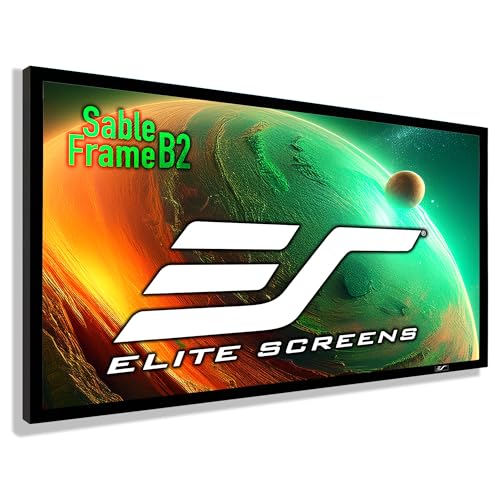
- Best Overall: Elite Screens Sable Frame B2 (SB120WH2)Best for dark home theaters and every projector type.
- Best Value: Silver Ticket STR-169120Best for a first home theater on a tighter budget.
- Best for Rooms with Some Light: Elite Sable Frame CineGrey 3D (ER120DHD3)Best for ceiling-mounted projectors in living rooms.
- Best for UST Projectors: Elite Aeon CLR (AR123H-CLR)Best for ultra-short-throw projectors with the lights on.
- Best Acoustically Transparent: Silver Ticket STT-169120-WABBest for speakers hidden behind the screen.
- Best Budget Grey: Silver Ticket STR-169120-HCBest for a contrast boost in dim rooms.
- Best Edge-Free Look: Elite Aeon CineGrey 3D (AR120DHD3)Best for a TV-like look with a standard projector.
Comparison table
| Screen | Best for | Surface / gain | Viewing angle | Frame | Projector type | Amazon |
|---|---|---|---|---|---|---|
| Elite Sable Frame B2 SB120WH2 | Overall | CineWhite UHD-B, 1.3 | 180° | 2.75" velvet aluminum | Standard, short, UST | Check price |
| Silver Ticket STR-169120 | Value | White, 1.1 | 160° | 2 3/8" velvet aluminum, 6 pieces | Long, short, UST (some UST not compatible) | Check price |
| Elite Sable Frame CineGrey 3D ER120DHD3 | Some light | CineGrey 3D, 1.2 | 90° | 2.36" velvet | Standard throw only | Check price |
| Elite Aeon CLR AR123H-CLR | UST | CLR (ALR), 0.6 | 180° | Edge-free | UST only | Check price |
| Silver Ticket STT-169120-WAB | Speakers behind | Woven acoustic, 1.1 | 160° | Thin bezel, 6 pieces | Standard | See options |
| Silver Ticket STR-169120-HC | Budget grey | High contrast grey, 0.95 | Not stated in listing | 6-piece aluminum | Not for short throw or UST | Check price |
| Elite Aeon CineGrey 3D AR120DHD3 | Edge-free | CineGrey 3D, 1.2 | Not stated in our sources | Edge-free | Standard throw | Check price |


The best fixed frame projector screens, reviewed
1. Elite Screens Sable Frame B2 120" (SB120WH2): Best Overall
Who it's for: dedicated theaters, basements and media rooms where you control the lights, with any type of projector.
The Sable Frame B2 is the fixed frame screen we'd recommend first. Elite lists ISF-certified CineWhite UHD-B material at 1.3 gain with a 180° viewing angle and full black backing, so the picture stays bright from every seat on a wide sofa and no light leaks through to the wall. Elite also lists it as compatible with standard, short-throw and ultra-short-throw projectors, which is unusually flexible for a white screen.
Installation is friendly for a framed screen. The 2.75-inch black aluminum frame is velvet-coated, the material is held taut by a rod-and-spring tensioning system, and the sliding wall brackets let you shift the screen sideways after it's hung to center it without drilling new holes. Elite includes the sliding wall brackets, drywall anchors and screws. Make sure you order the 120-inch SB120WH2 (viewing area about 104.7 x 58.7 inches) or whichever size our screen size calculator recommends.
Pros
- 1.3 gain and 180° viewing angle
- Works with standard, short and UST projectors
- Sliding brackets make centering easy
- 2-year warranty from a US-based company
Cons
- White surface needs a dark room to shine
- Costs more than Silver Ticket's white frame
- Check the size and model number before you order
2. Silver Ticket STR-169120: Best Value
Who it's for: first home theaters and anyone who wants a real tensioned frame without paying for a premium brand.
Silver Ticket's STR series has been a budget home theater staple for years. The STR-169120 is a 120-inch, 16:9 screen with a white 1.1 gain surface and a 160° viewing angle, stretched with a tensioning rod system over a 6-piece, 2 3/8-inch beveled aluminum frame wrapped in black velvet. The viewing area is 104.5 x 58.875 inches and the overall size 109.25 x 63.625 inches.
A 1.1 gain white surface is close to neutral, which means accurate color and an even picture. Silver Ticket says it works with long, short and ultra-short-throw projectors, but also notes that some UST projectors aren't compatible with the STR frame and points UST owners to its S7 frame series. It's wall mounted only, with no legs or stand option.
Pros
- Tensioned fixed frame at a value price
- Near-neutral 1.1 gain white
- Top and bottom brackets allow horizontal adjustment
Cons
- Some UST projectors not compatible with this frame
- 6-piece frame takes time to assemble
- Not acoustically transparent

Silver Ticket STR-169120 120-inch Fixed Frame Screen
by Silver Ticket
3. Elite Screens Sable Frame CineGrey 3D 120" (ER120DHD3): Best for Rooms with Some Light
Who it's for: living rooms and bonus rooms with a ceiling- or shelf-mounted standard-throw projector, where you can't make it fully dark.
CineGrey 3D is Elite's ambient light rejecting surface for normal projectors. The listing gives a 1.2 gain, a 90° viewing angle and a claimed 65% rejection of ceiling light. A grey ALR surface keeps blacks from turning milky when a lamp is on, and the 1.2 gain recovers some of the brightness a grey screen usually loses.
Two limits matter. The 90° viewing angle is half that of the white Sable Frame B2, so very wide seating rows will see some falloff at the ends. And Elite says it's for standard-throw projectors only, not short-throw, UST or triple-laser models. If you're deciding between surfaces, our grey vs white projector screen guide walks through the trade-off.
Pros
- Rejects ceiling light for better contrast
- 1.2 gain offsets the grey surface
- Same easy fixed-frame install
Cons
- 90° viewing angle
- Standard throw only
- Not for triple-laser projectors

Elite Screens Sable Frame CineGrey 3D 120-inch ER120DHD3
by Elite Screens
4. Elite Screens Aeon CLR 123" (AR123H-CLR): Best for UST Projectors
Who it's for: bright living rooms where an ultra-short-throw projector replaces the TV.
UST projectors sit a few inches from the wall and fire light steeply upward, which standard screens handle poorly. The Aeon CLR is built for that angle: Elite describes its ceiling light rejecting material as rejecting up to 95% of overhead light, with a 0.6 gain and a 180° viewing angle, in an edge-free frame that looks more like a giant TV than a theater screen.
The rule is strict. Elite lists it as exclusively for UST projectors, so a ceiling-mounted projector will look dim and uneven on it. Check your projector's distance chart for 123 inches, pair it with a UST model from our ultra short throw projector guide and you can watch with lights on in a way a white screen can't match.
Pros
- Up to 95% overhead light rejection (Elite's figure)
- Wide 180° viewing angle for an ALR screen
- Edge-free, TV-like design
Cons
- UST projectors only
- Premium price tier
- Edge-free frame demands precise image alignment

Elite Screens Aeon CLR 123-inch AR123H-CLR
by Elite Screens
5. Silver Ticket STT-169120-WAB: Best Acoustically Transparent
Who it's for: dedicated theaters that want the center and front speakers hidden behind the screen, like a real cinema.
The STT-169120-WAB pairs Silver Ticket's thin-bezel 6-piece fixed frame with a woven acoustic material. Silver Ticket says the woven material lets speakers sit behind the viewing surface with no sound loss, and lists it at 1.1 gain with a 160° viewing angle. The thin bezel maximizes the viewing area for the wall space it takes.
Woven acoustic screens have a fine texture, so they work best when you sit far enough back that the weave isn't visible, and they need a dark room like any white surface. Leave a few inches between the speakers and the screen so the material can't vibrate against the drivers. Woven materials generally avoid the moiré patterns that perforated screens can show with some projectors.
Pros
- Speakers can hide behind the picture
- 1.1 gain, 160° viewing angle
- Thin bezel maximizes picture area
Cons
- Weave can show at close seating distances
- Dark rooms only
- Fewer published specs than Elite

Silver Ticket STT-169120-WAB 120-inch Woven Acoustic Screen
by Silver Ticket
Currently unavailable on Amazon
6. Silver Ticket STR-169120-HC: Best Budget Grey
Who it's for: dim rooms that are rarely pitch black, with a standard projector on a ceiling mount or shelf.
The STR-169120-HC is the STR frame with a high-contrast dark grey surface at 0.95 gain. It isn't an angular ALR screen. It's a grey screen that lowers the black floor, so stray light and the projector's own black level look darker than on white. Silver Ticket lists a viewing area of 104.5 x 58.875 inches and says it's not recommended for short-throw or UST projectors.
Think of it as a cheaper step toward contrast, not a fix for daylight. In a room with windows and overhead lights, a true ALR surface like CineGrey 3D will do far more.
Pros
- Deeper blacks than white in dim rooms
- Value price for a tensioned grey screen
- Same 6-piece frame as the white STR
Cons
- Not true ALR
- Dimmer than white (0.95 gain)
- Not for short throw or UST

Silver Ticket STR-169120-HC 120-inch High Contrast Screen
by Silver Ticket
7. Elite Screens Aeon CineGrey 3D 120" (AR120DHD3): Best Edge-Free Look
Who it's for: living rooms where a thick black border would look out of place, with a standard projector doing the work.
This is the same CineGrey 3D material (1.2 gain per the listing) in Elite's edge-free Aeon frame instead of the velvet Sable border. Elite lists this version as ISF certified. The thin edge makes the screen read as a modern display rather than a theater fixture.
Edge-free screens have no wide black border to hide overspill, so the projector must be aligned precisely. Use your projector's zoom and lens shift, and avoid heavy digital keystone, which softens the picture. Like the Sable version, it's for standard-throw projectors.
Pros
- Modern, borderless look
- ALR performance for standard projectors
- ISF certified per Elite
Cons
- Needs precise projector alignment
- Costs more than the Sable Frame version
- Standard throw only

Elite Screens Aeon CineGrey 3D 120-inch AR120DHD3
by Elite Screens
How to choose a fixed frame projector screen
Fixed frame vs motorized vs pull-down
| Fixed frame | Motorized | Pull-down | |
|---|---|---|---|
| Flatness | Best: always tensioned | Good, best if tab-tensioned | Fair, edges can wave |
| Surface options | Widest (white, grey, ALR, acoustic) | Moderate | Limited |
| Hides away | No | Yes | Yes |
| Install | Frame on wall brackets | Case, brackets and power | Hooks or brackets |
| Amazon | See options | See options | See options |
If the wall can be dedicated to the screen, a fixed frame gives the best picture for the money. If the screen must vanish, a tab-tensioned motorized screen is the closest alternative.
Size and the overall frame
Pick the diagonal from your seating distance first: a 120-inch 16:9 screen suits seats roughly 12 to 16 ft away by the SMPTE and THX viewing-angle guidance. Then check the overall frame size. Silver Ticket's 120-inch STR measures 109.25 x 63.625 inches overall versus a 104.5 x 58.875-inch picture, so you need several inches of extra wall in each direction.
Surface: white, grey, ALR or acoustic
- White (1.0 to 1.3 gain): brightest and most accurate, best in a dark room.
- Grey (around 0.8 to 1.0): deeper blacks in dim rooms, less brightness.
- Angular ALR (CineGrey 3D, CLR): rejects light from specific directions; matched to standard or UST projectors.
- Acoustically transparent: woven or perforated, so speakers can sit behind.
Our ALR projector screen guide explains how ALR surfaces work and why they're tied to projector angle.
Projector compatibility
This is where buyers go wrong most often. Check the listing for your projector type:
- Standard throw (ceiling or shelf): any white screen, grey screens, CineGrey 3D.
- Short throw: white screens listed for short throw, such as the Sable Frame B2.
- UST: a white screen listed for UST, or a dedicated UST ALR like the Aeon CLR. Never a standard-throw ALR.
Frame width and appearance
A wider velvet border (around 2.4 to 2.75 inches) frames the picture and absorbs overspill, which forgives slight misalignment. Thin-bezel and edge-free frames look sleeker but demand precise setup.
Installation
Fixed frames hang on wall brackets, usually two at the top and two at the bottom. Fix the brackets into studs where possible, use the anchors supplied for drywall where the manual allows, and assemble the frame on a clean floor. Our how to hang a projector screen guide covers measuring, height and bracket placement.
How we chose
We didn't install these screens ourselves. We compared manufacturer and retailer listings from Elite Screens and Silver Ticket for surface type, gain, viewing angle, projector compatibility, frame design and installation hardware, and we looked at recurring owner feedback about assembly, flatness and viewing angles. Where a listing hedges, such as Silver Ticket's note that some UST projectors don't suit the STR frame, we pass that on rather than simplify it.
FAQ
Is a fixed frame projector screen worth it?
Yes, if the screen can stay on the wall. A fixed frame keeps the material stretched flat all the time, so you get no waves or curled edges, a clean black border that hides overspill, and the widest choice of surfaces including ALR and acoustically transparent. The trade-off is that it never disappears like a motorized or pull-down screen.
What size fixed frame screen should I buy?
Start from your seating distance. By the SMPTE and THX viewing-angle guidance, a 120-inch 16:9 screen suits seats roughly 12 to 16 ft away and a 100-inch screen suits about 10 to 13.6 ft. Then check that the overall frame size, which is a few inches larger than the picture, fits your wall.
Can you use a fixed frame screen with a short throw or UST projector?
Only with a surface the maker lists for it. Elite says the Sable Frame B2 white screen works with standard, short and ultra-short-throw projectors, while its CineGrey 3D grey screen is for standard throw only. UST ALR screens such as the Aeon CLR work only with UST projectors.
How high should a fixed frame screen be mounted?
Most home theaters put the bottom of the picture roughly 2 to 3 ft above the floor so the center sits near seated eye level, but your ceiling height and front-row seating decide it. Mark the frame outline on the wall with painter's tape and sit in the main seat before drilling.
Are fixed frame screens hard to assemble?
Not hard, but they take floor space and patience. You assemble the aluminum frame flat, then attach the material with tension rods, springs or snaps around the edge. Two people make it easier, especially at 120 inches and larger.
Verdict
The Elite Screens Sable Frame B2 is the best fixed frame projector screen for most home theaters: bright, wide-angle and compatible with every projector type. Silver Ticket's STR-169120 is the value pick, and its woven acoustic sibling suits theaters with speakers behind the screen. If your room has light, choose CineGrey 3D for a standard projector or the Aeon CLR for a UST, and compare the two brands in our Elite Screens vs Silver Ticket guide.