We research products independently. When you buy through links on this page, we may earn a commission from Amazon at no extra cost to you. As an Amazon Associate we earn from qualifying purchases. Read our affiliate disclosure.
A high lumen projector is the answer when your room has windows you can't cover, when you want a very large screen, or when sports and daytime TV are the main event. More brightness lifts the picture above the room's light, so the image stays colorful instead of washed out.
But brightness isn't free. What matters when you choose is how the lumens are rated, whether the projector's size and noise suit your room, and whether the screen can hold the contrast. Below are six bright projectors, from living room 4K models to WUXGA installation units.
Our top picks at a glance


Quick picks
- Best Overall: Hisense XR10Best for a 6,000 ANSI lumen 4K triple laser with huge placement range.
- Best for Living Rooms: XGIMI Horizon 20 MaxBest for brightness in a more compact home design.
- Best for Large Rooms: ViewSonic LS920WUBest for screens up to 300 inches in halls and offices.
- Best Value Bright Laser: ViewSonic LS740HDBest for bright 1080p at a lower tier.
- Best 3LCD: Epson Pro EX11000Best for equal color and white brightness.
- Best Bright 4K Value: Optoma UHZ66Best for a long-life 4K laser at 4,000 lumens.
Comparison table
| Projector | Best for | Brightness (maker's rating) | Resolution | Light source | Throw ratio | Rated light life | Amazon |
|---|---|---|---|---|---|---|---|
| Hisense XR10 | Overall | 6,000 ANSI lumens | 4K UHD | RGB triple laser | 0.84–2.0 | 25,000 hours | Check price |
| XGIMI Horizon 20 Max | Living rooms | 5,700 ISO lumens | 4K (pixel shift) | RGB triple laser | 1.2–1.5 | Not stated | Check price |
| ViewSonic LS920WU | Large rooms | 6,000 ANSI lumens | WUXGA (1920 x 1200) | Laser phosphor | 1.36–2.18 | 20,000 hours | Check price |
| ViewSonic LS740HD | Value | 5,000 ANSI lumens | 1080p | Laser phosphor | 1.13–1.47 | 20,000 hours | Check price |
| Epson Pro EX11000 | 3LCD | 4,600 lumens color/white | 1080p | Laser, 3LCD | 1.32–2.12 | 20,000 hours | Check price |
| Optoma UHZ66 | Bright 4K | 4,000 ANSI lumens | 4K UHD | Laser phosphor | 1.4–2.24 | 30,000 hours | See options |




Brightness ratings use different standards. Independent measurements, where we found them, are mentioned in each review.
The best high lumen projectors, reviewed
1. Hisense XR10: Best Overall
Who it's for: bright living rooms and large home theaters where you want both output and placement flexibility.
The XR10 is rated at 6,000 ANSI lumens from an RGB triple laser, with a 25,000-hour rated light source. ProjectorCentral lists HDR10+, Dolby Vision, HLG and HDR10. Hisense pairs that brightness with a very wide 2.38x zoom, covering a 0.84 to 2.0:1 throw. A 100-inch screen can sit from about 6.1 to 14.5 ft away, a range almost no other projector matches.
Lens shift is huge too, at ±130% vertical and ±46% horizontal. It's a big projector at 23.4 lb, so plan the mount around that. If you're stuck with a room where the projector has to go in an awkward spot, this is the one that's most likely to work.
Pros
- 6,000 ANSI lumens, 4K triple laser
- Enormous zoom and lens shift
- Dolby Vision and HDR10+
- 25,000-hour rated life
Cons
- 23.4 lb needs a strong mount
- Premium price tier
- Triple-laser speckle for some viewers
2. XGIMI Horizon 20 Max: Best for Living Rooms
Who it's for: living rooms that need real brightness without an installation-size projector.
XGIMI rates the Horizon 20 Max at 5,700 ISO lumens, and ProjectorCentral measured 5,342 ANSI lumens in the brightest mode, about 6% under the rating. For a home projector that's a very bright, independently checked number, in a chassis with optical zoom and lens shift of ±120% vertical and ±45% horizontal.
Google TV and Dolby Vision make it usable as a daily TV replacement, which is what most high lumen buyers in living rooms want. Weighing the switch? See whether a projector can replace your TV. A 1.2 to 1.5:1 throw needs about 8.7 to 10.9 ft for 100 inches. Pair it with an ALR screen matched to its throw, and it can handle a lot of room light.
Pros
- 5,700 ISO lumens, independently close to rating
- Google TV built in
- Optical zoom and lens shift
Cons
- Premium price tier
- Pixel shift rather than native 4K
- Triple-laser speckle for some viewers
3. ViewSonic LS920WU: Best for Large Rooms
Who it's for: halls, classrooms and big media rooms using very large screens.
The LS920WU is a 6,000 ANSI lumen laser projector with WUXGA 1920 x 1200 resolution, which is slightly taller than 1080p and popular for slides and presentations. ProjectorCentral lists a 20,000-hour light source and a 1.36 to 2.18:1 throw from a 1.6x zoom, with lens shift of ±50% vertical and ±23% horizontal.
ViewSonic markets it for screens up to 300 inches, and its 14.3 lb chassis is a lot lighter than the Hisense. It's an installation-style projector, so it doesn't have the home-theater polish of the XGIMI, but it makes sense for a large room where brightness comes first.
Pros
- 6,000 ANSI lumens
- Lens shift in both directions
- Reasonable 14.3 lb for its output
Cons
- WUXGA rather than 4K
- Installation-style feature set
- No smart platform listed
4. ViewSonic LS740HD: Best Value Bright Laser
Who it's for: those who need serious brightness and will happily stream through an external box.
The LS740HD gives you a 5,000 ANSI lumen rating at 1080p, with ViewSonic's US page advertising 5,500 lumens as a center-brightness figure. ProjectorCentral measured 4,783 lumens in Bright mode, which is close to the rating and rare to see confirmed. A 1.13 to 1.47:1 throw means about 8.2 to 10.7 ft for a 100-inch screen.
Its laser is rated for 20,000 hours, or 30,000 in SuperEco. If your priority is sports and daytime TV in a family room, the jump from 1080p to 4K often matters less than extra lumens, which is why this is the value pick. For more Full HD options, see our best 1080p projector picks.
Pros
- 5,000 ANSI lumens, close to measured
- Long-life laser
- Lower tier than bright 4K models
Cons
- 1080p
- No built-in smart platform
- Business-oriented sound

5. Epson Pro EX11000: Best 3LCD
Who it's for: anyone who wants bright color, not just bright white.
The Pro EX11000 is a laser 3LCD projector rated at 4,600 lumens of both color and white brightness, with a 20,000-hour rated light source. That equal rating is the real strength here: some bright single-chip DLP projectors publish a high white number but put out less brightness in color. With 3LCD, the color stays right there with the white.
A 1.6x zoom gives a 1.32 to 2.12:1 throw, or about 9.6 to 15.4 ft for 100 inches. Built-in Miracast and dual HDMI suit shared spaces. It's 1080p, so this is a pick for color and clarity in bright rooms rather than fine detail.
Pros
- 4,600 lumens color and white
- 20,000-hour rated laser
- Wide zoom range
Cons
- 1080p
- Business-focused
- Less brightness than 6,000-lumen models
6. Optoma UHZ66: Best Bright 4K Value
Who it's for: buyers who want 4K and strong brightness without moving to the 5,000-lumen tier.
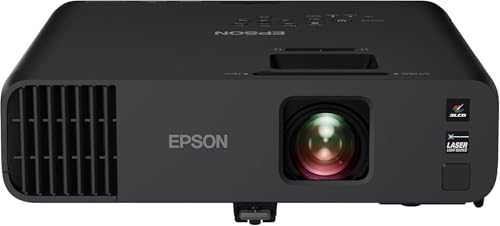
The UHZ66 is rated at 4,000 ANSI lumens with a 30,000-hour laser, and it's light at 6.6 lb. A 1.4 to 2.24:1 throw needs about 10.2 to 16.3 ft for 100 inches, so it suits a rear ceiling mount. ProjectorCentral lists gaming input lag down to 4.4 ms at 1080p and 240Hz.
There's no lens shift, so you'll need to mount it at the right height. ProjectorCentral lists a 1.6x zoom in the spec table and 1.3x in the highlights, so verify throw before installing. For most lit rooms, 4,000 lumens is the point where a 100-inch picture starts to hold up, especially on an ALR surface matched to its throw.
Pros
- 4K at 4,000 ANSI lumens
- 30,000-hour rated laser
- Light 6.6 lb
Cons
- No lens shift
- Long throw
- Sources disagree on the zoom range

Optoma UHZ66 4K Laser Projector
by Optoma
Currently unavailable on Amazon
How to choose a high lumen projector
Work out how many lumens you need
A simple formula tells you how much light the screen needs. Lumens = target foot-lamberts x screen area in sq ft ÷ gain. ProjectorCentral explains that the common target is 16 foot-lamberts in a dark room (SMPTE allows 12 to 22) and about 50 for a family room with some light.
| Screen (16:9) | Area | Dark room, 16 ft-L | Lit room, 50 ft-L |
|---|---|---|---|
| 100 inch | 29.7 sq ft | About 475 lumens | About 1,485 lumens |
| 120 inch | 42.7 sq ft | About 685 lumens | About 2,135 lumens |
| 150 inch | 66.7 sq ft | About 1,065 lumens | About 3,335 lumens |
Those are lumens reaching a 1.0 gain screen. Real projectors produce less in their better-looking picture modes than their rated maximum, and lamps dim with age, so add a healthy margin. Our guide to how bright 15,000 lumens really is walks through more examples.
Rated lumens aren't all equal
ANSI and ISO lumens are measured in comparable ways. "Light source lumens" and vague "LED lumens" are not. Even honest ratings describe the projector's brightest, least accurate mode. Where we found an independent measurement, we've noted it. Check reviews with measured results before you trust a headline number.
Color brightness matters
Single-chip DLP models can put out less color brightness than white, while 3LCD projectors have equal color and white output by design. That's why the Epson's 4,600 lumens can look brighter than a higher-rated DLP in a colorful scene.
The screen does half the job
A bright projector on a white screen still gets washed out by daylight, because the screen reflects the room's light too. If you can't control the room, pair the projector with an ALR projector screen that matches its throw distance. Note that ALR surfaces are throw-specific: a surface built for a ceiling-mounted long-throw projector won't work with a short-throw.
Size, weight and noise
More lumens means more heat, and most very bright projectors are big and have audible fans. Check the projector's weight against your mount's limit, and think about how close you'll sit. A 23-lb projector over your head needs a joist-mounted, properly rated mount.
Bright enough to be too bright
In a dark room, 5,000 lumens is too much for a 100-inch screen. Use the projector's Eco mode, or a darker screen. Some enthusiasts move to a bigger screen, which spreads the light and uses that output well.
Match the output to the job
| Use | Practical brightness tier |
|---|---|
| Dark room, 100–120 inches | 2,000–3,000 lumens |
| Living room with some light, up to 120 inches | 4,000–5,000 lumens plus an ALR screen |
| Very large home screen (150 inches and up) | 5,000 lumens and up |
| Halls, houses of worship, large classrooms | 6,000 lumens and up |
These tiers follow from the area-and-target math above, with room for picture modes that run below peak brightness. Outdoors, darkness matters more than the last 1,000 lumens, so start the movie after sunset.
How we chose
We didn't test these projectors ourselves. We compared maker listings and retailer specs with ProjectorCentral's spec database and its published brightness measurements, and we kept only models shown as current products. We prioritized honestly rated output, zoom range and whether the design suits a home or a venue. Where ratings conflict, we say so.
FAQ
What is the brightest projector you can buy for home use?
Among the consumer-style models we compared, the Hisense XR10 is rated at 6,000 ANSI lumens and the XGIMI Horizon 20 Max at 5,700 ISO lumens. Installation projectors go higher, but they are large, loud and priced for venues rather than living rooms.
How many lumens do you need for daylight viewing?
There's no single number because daylight varies, but the common 50 foot-lambert target for lit rooms works out to about 1,500 lumens at the screen for 100 inches and about 2,100 lumens for 120 inches with a 1.0 gain surface. Real rooms with windows often need more, plus an ALR screen.
Is a high lumen projector too bright for a dark room?
It can be. In a dark room you only need around 16 foot-lamberts at the screen, so a 5,000-lumen projector on a 100-inch screen would be far too bright at full power. Use Eco mode, a dimmer picture mode or a bigger screen to bring the light down.
Are ANSI lumens and ISO lumens the same?
They are close but not identical, and marketing figures vary. ANSI and ISO lumens use similar methods, while terms like LED lumens or light source lumens are not comparable. Independent measurements, when available, are the most reliable guide.
Do high lumen projectors need an ALR screen?
Not always, but it's the best way to use them in a lit room. A bright projector on a plain white screen still has its blacks washed out by daylight. An ALR screen matched to your projector's throw keeps contrast by rejecting light from other directions.
Verdict
The Hisense XR10 is the best high lumen projector for most big, bright rooms, combining 6,000 ANSI lumens with a huge zoom range. For a smaller, more home-friendly body, choose the XGIMI Horizon 20 Max. The ViewSonic LS740HD is the value pick, the ViewSonic LS920WU suits halls and large rooms, the Epson Pro EX11000 wins on color brightness and the Optoma UHZ66 gives you 4K at a lower tier. For outdoor screens, see our best projector for outdoor movies.