We research products independently. When you buy through links on this page, we may earn a commission from Amazon at no extra cost to you. As an Amazon Associate we earn from qualifying purchases. Read our affiliate disclosure.
The best projector for a home movie theater isn't necessarily the brightest. In a dark room, contrast, color and how cleanly the projector fits your space matter far more. A projector that has to be keystoned into place or sits too close will never look as good as one that fits the room.
Start with throw distance: how far back can the projector go? Then think about how dark the room gets, whether you want a laser or lamp, and how much you care about native 4K. Below are six projectors for dedicated theaters and hybrid rooms, from native 4K SXRD to value picks that still look great in the dark.
Our top picks at a glance


Quick picks
- Best Overall: Epson Home Cinema LS11000Best for flexible placement and laser convenience.
- Best Native 4K: Sony BRAVIA Projector 7Best for true 4K panels and a big step up in detail.
- Best for Color Accuracy: BenQ W4100iBest for film fans who care about color first.
- Best for Dual-Use Rooms: XGIMI Horizon 20 MaxBest for rooms used day and night.
- Best Value 4K: BenQ W2720iBest for a 4K theater picture at a lower tier.
- Best Under a Premium Budget: Epson Home Cinema 2350Best for 3LCD 4K with lens shift on a lamp.
Comparison table
| Projector | Best for | Resolution | Brightness (maker's rating) | Light source | Throw ratio | Lens shift | Amazon |
|---|---|---|---|---|---|---|---|
| Epson LS11000 | Overall | 4K PRO-UHD (pixel shift) | 2,500 lumens color/white | Laser, 3LCD | 1.35–2.84 | ±96.3% V, ±47.1% H | Check price |
| Sony BRAVIA Projector 7 | Native 4K | Native 4K SXRD | 2,200 lumens | Laser phosphor | 1.38–2.21 | ±71% V, ±25% H | Check price |
| BenQ W4100i | Color | 4K (DLP) | 3,200 ANSI lumens | LED | 1.15–1.5 | Up to 60% V, ±15% H | Check price |
| XGIMI Horizon 20 Max | Dual-use rooms | 4K (pixel shift) | 5,700 ISO lumens | RGB triple laser | 1.2–1.5 | ±120% V, ±45% H | Check price |
| BenQ W2720i | Value 4K | 4K (DLP) | 2,500 ANSI lumens | LED | 1.0–1.3 | ±5% V | Check price |
| Epson Home Cinema 2350 | Lens shift on a lamp | 4K PRO-UHD (pixel shift) | 2,800 lumens color/white | Lamp, 3LCD | 1.32–2.15 | ±60% V | Check price |



Brightness figures use different standards, so read them as tiers. Lens-shift and throw figures come from ProjectorCentral's spec database and retailer spec sheets.
The best home theater projectors, reviewed
1. Epson Home Cinema LS11000: Best Overall
Who it's for: dedicated theaters and basements where the projector can go on the ceiling or a rear shelf.
The LS11000 is a laser 3LCD projector with Epson's 4K PRO-UHD pixel shifting, rated at 2,500 lumens of color and white brightness and 20,000 hours of light source life. It's the easiest projector here to fit into an existing room, because a 1.35 to 2.84:1 zoom fills a 120-inch screen from roughly 11.8 to 24.8 ft away. If your seating position or mounting point is fixed, there's a good chance this lens reaches it.
Lens shift is huge, at ±96.3% vertical and ±47.1% horizontal, and you control it with the motorized lens listed by Epson, so you never have to keystone the picture. 3LCD also avoids the rainbow artifacts some viewers see from a DLP color wheel. It's the projector to choose if you want a set-and-forget theater.
Pros
- Massive 2.1x zoom and lens shift
- 20,000-hour rated laser
- No rainbow artifacts with 3LCD
- HDR10+ listed
Cons
- Lower brightness makes it weaker in lit rooms
- No built-in streaming listed
- Premium price tier
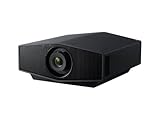
2. Sony BRAVIA Projector 7: Best Native 4K
Who it's for: enthusiasts who want native 4K panels and don't mind paying for them.
Sony's BRAVIA Projector 7 (VPL-XW5100ES) uses three 0.61-inch SXRD panels at native 4K, with a laser phosphor light source. ProjectorCentral's spec table rates it at 2,200 lumens (its highlights cite 2,000, so we treat that as a range). Native panels mean no pixel shifting, and Sony's HDR tools are listed as Dynamic HDR Enhancer and Object-based HDR Remaster.
A 1.6x manual zoom gives a 1.38 to 2.21:1 throw, or about 12 to 19.3 ft for 120 inches, and lens shift is ±71% vertical and ±25% horizontal. At 28 lb, this is a projector to install and leave in place, so make sure your mount handles the weight. The previous VPL-XW5000ES is still around, but B&H shows this model as its replacement. 3D isn't listed on this model.
Pros
- Native 4K SXRD panels
- Substantial zoom and lens shift
- Laser light source
Cons
- Premium price tier
- 28 lb needs a robust mount
- 3D not listed
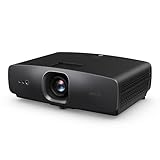
3. BenQ W4100i: Best for Color Accuracy
Who it's for: film fans who want a calibrated-looking picture straight out of the box.
The W4100i is an LED 4K DLP projector rated at 3,200 ANSI lumens and 20,000 hours (30,000 in Eco). BenQ's listing highlights 100% DCI-P3 coverage and factory calibration, along with HDR10+ and Android TV with Netflix. Its throw of 1.15 to 1.5:1 suits smaller theaters, at about 10 to 13 ft for 120 inches.
Lens shift is a strong point for a DLP at this tier, listed at up to 60% vertical and ±15% horizontal. That makes it far easier to place on a shelf behind the seats, or to mount without tilting. ProjectorCentral lists it with Full HD 3D support, which is uncommon on newer models. Our guide to 3D projectors lists models that still support it.
Pros
- 100% DCI-P3 per BenQ
- LED light source with long rated life
- Lens shift in both directions
- Android TV built in
Cons
- DLP rainbow artifacts for sensitive viewers
- Shorter zoom than the Epson
- Premium price tier
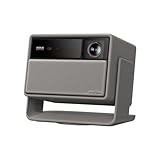
4. XGIMI Horizon 20 Max: Best for Dual-Use Rooms
Who it's for: family rooms that are a theater at night and a living room by day.
Dark-room purists don't need 5,700 ISO lumens, but rooms that see some daylight do. The Horizon 20 Max's triple-laser brightness (ProjectorCentral measured 5,342 ANSI lumens in the brightest mode) gives you headroom to watch in lit rooms, while Dolby Vision and HDR10+ support make the most of movies at night. Optical zoom and lens shift keep placement flexible.
Its throw of 1.2 to 1.5:1 means about 10.5 to 13.1 ft for 120 inches. Google TV with licensed Netflix keeps it simple for the whole family. In a truly dark room, consider a calmer, phosphor-based or 3LCD option if you're sensitive to triple-laser speckle.
Pros
- Very bright, with independent confirmation
- Optical zoom and large lens shift
- Dolby Vision and HDR10+
Cons
- Overkill for a true dark theater
- Triple-laser speckle for some viewers
- Premium price tier

XGIMI Horizon 20 Max 4K Triple Laser Projector
by XGIMI
5. BenQ W2720i: Best Value 4K
Who it's for: first-time theater builders with a shorter room.
The W2720i is BenQ's lower-priced 4K home theater model, rated at 2,500 ANSI lumens with an LED light source rated for 20,000 hours (30,000 in Eco). BenQ's listing cites 95% DCI-P3 coverage, HDR10/HLG and Android TV. Its 1.0 to 1.3:1 throw is short for a home-theater projector, roughly 8.7 to 11.3 ft for 120 inches, which suits smaller basements and spare rooms.
Lens shift is small, at ±5% vertical, so placement needs some care: mount it close to the right height for your screen. For the price tier, though, it delivers a lot of what enthusiasts care about.
Pros
- Short throw for smaller rooms
- LED light source, long rated life
- 95% DCI-P3 per BenQ
Cons
- Limited lens shift
- Less bright than some rivals
- DLP rainbow artifacts for sensitive viewers

6. Epson Home Cinema 2350: Best Under a Premium Budget
Who it's for: buyers who want 4K and 3LCD without moving to the laser price tier.
The Home Cinema 2350 uses three LCD panels and pixel shifting from a native 1080p panel to display a 4K picture, and Epson rates it at 2,800 lumens of color and white brightness. The throw is 1.32 to 2.15:1 (or 1.34 to 2.17 at ProjectorCentral), so 120 inches needs roughly 11.5 to 18.7 ft, and ±60% vertical lens shift makes mounting forgiving.
The compromise is the lamp, rated at 4,500 hours or 7,500 in Eco. Android TV is built in, and it's one of the best-value ways to get real lens shift for a dedicated room.
Pros
- 3LCD 4K PRO-UHD
- ±60% vertical lens shift
- Long zoom for flexible placement
Cons
- Lamp needs eventual replacement
- Pixel shift, not native 4K
- Not as bright or contrasty as premium models

Epson Home Cinema 2350 4K Smart Projector
by Epson
How to choose a projector for a home movie theater
Start with the room
Measure where the projector can go first. Throw ratio times screen width gives you the distance. A 120-inch 16:9 screen is about 8.7 ft wide, so a 1.2:1 lens needs about 10.5 ft while a 2.0:1 lens needs about 17.4 ft. Use our throw ratio calculator with the exact figures from each model.
Then size the screen for your seating. Bigger isn't always better: the screen size calculator shows where 100, 120 or more inches fits your row.
Contrast matters more than lumens
In a dark room, contrast is what you actually see. A very bright projector can look washed out if its blacks aren't deep, so don't shop for a theater on lumens alone. Native contrast figures aren't standardized across brands, so read reviews with measured results when you can.
Dark walls and ceilings help as much as any projector upgrade, because white walls reflect the image back onto the screen and lift the blacks.
Laser, LED or lamp
Laser and LED models start up quickly and don't need bulb changes. Lamp projectors remain a good value and can look excellent, but their brightness falls as the lamp ages. In a true dark theater, some enthusiasts prefer lamp or phosphor sources for a smooth image; triple-laser models are brighter, but can show speckle on some screens.
Lens shift and zoom
These two features matter more in a theater than they do anywhere else, because you can't move the wall. Lens shift moves the picture without moving the projector or losing sharpness. Zoom changes how far back it can sit. Avoid relying on digital keystone in a theater, since it softens the image.
Native 4K or pixel shift
Pixel-shift projectors flash a smaller panel to place more pixels on screen. At normal seating distances most people can't tell the difference from native 4K, and pixel-shift models cost much less. Native 4K shows its advantage when you sit close to a very large screen.
Screen pairing
For a dark theater, use a matte white surface around 1.0 to 1.3 gain, as explained in our grey vs white projector screen comparison. Our fixed frame projector screen guide has the tensioned models worth pairing with these projectors. If you plan to mount the projector, see our ceiling mount guide and check the projector's weight first.
How we chose
We didn't test these projectors ourselves. We compared maker listings with ProjectorCentral's spec database, its published measurements and B&H listings, keeping only models shown as current. We focused on lens shift, zoom range, light source, brightness and resolution, since those determine whether a projector fits a real room. Where sources disagree, we say so.
FAQ
What is the best projector for a home theater?
For most dedicated rooms, the Epson Home Cinema LS11000 is the best balance of placement range, laser reliability and picture. If you want native 4K panels and have the budget, the Sony BRAVIA Projector 7 is the step up. The right choice depends on your throw distance and how dark the room gets.
How many lumens do I need for a home theater?
In a room that's truly dark, far fewer than you'd expect. For a 120-inch screen of about 42.7 sq ft, the SMPTE target of 16 foot-lamberts works out to about 685 lumens at the screen with a 1.0 gain surface. Choosing a 2,000 to 3,000-lumen projector leaves headroom for lamp aging and HDR.
Is native 4K worth it for a home theater?
It is if you sit close to a large screen and want the best detail, but pixel-shift 4K models from Epson, BenQ and others look very sharp at normal distances and cost far less. Contrast and placement usually affect a theater picture more than the difference between native and pixel-shift 4K.
What screen should I use with a home theater projector?
In a dark room, a smooth matte white screen with gain around 1.0 to 1.3 is the safe, accurate choice. Grey or ALR surfaces are mainly for rooms with light you can't control, and they aren't needed in a dedicated theater.
Should a home theater projector be ceiling mounted?
Ceiling mounting keeps the projector out of the way and frees up the room, but a rear shelf works just as well and makes maintenance easier. Use the throw ratio to find the distance first, then look for a mount or shelf that puts the lens at that spot.
Verdict
The Epson Home Cinema LS11000 is the best projector for most home movie theaters because its zoom and lens shift solve the hardest part of a theater build: making the picture fit the room. Step up to the Sony BRAVIA Projector 7 for native 4K, choose the BenQ W4100i for color, the XGIMI Horizon 20 Max if the room sees daylight, and the BenQ W2720i or Epson 2350 to keep costs down.