We research products independently. When you buy through links on this page, we may earn a commission from Amazon at no extra cost to you. As an Amazon Associate we earn from qualifying purchases. Read our affiliate disclosure.
An ultra short throw projector is the projector that acts like a TV. It sits on your media console a few inches from the wall and throws a 100 to 150-inch picture upward onto the screen. No ceiling mount, no cable runs across the room, and nobody walks through the beam. Still deciding between the two? Our projector vs TV guide weighs it up.
Two things decide whether a UST setup looks great or disappointing: the projector's brightness and color (triple-laser and 3LCD models lead here), and the screen. UST light hits the screen at a steep angle, so a UST-specific ALR screen makes a dramatic difference in a living room with lights on. Below are six UST projectors from Hisense, Epson, AWOL Vision and Optoma, each with the screen we'd pair it with.
Our top picks at a glance


Quick picks
- Best Overall: Hisense PX3-PROBest for a bright, colorful triple-laser picture with Dolby Vision.
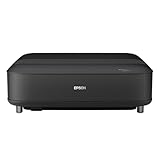
- Best for Bright Rooms: Epson EpiqVision Ultra LS800Best for the highest brightness rating here, 4,000 lumens.
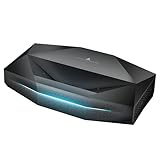
- Best for Movie Contrast: AWOL VISION Aetherion ProBest for dark scenes, with a dynamic iris.
- Best Built-In Sound: Epson Lifestudio GrandBest for sound by Bose without a soundbar.
- Best Value Triple Laser: Hisense PT1Best for triple-laser color at a lower tier.
- Best Portable UST: Optoma ML1080UST Photon GOBest for a battery-powered UST you can move.
Comparison table
| Projector | Best for | Resolution | Brightness (maker's rating) | Light source | Picture size (listing) | Amazon |
|---|---|---|---|---|---|---|
| Hisense PX3-PRO | Overall | 4K UHD | 3,000 lumens | RGB triple laser | 80–150" | Check price |
| Epson LS800 | Bright rooms | 4K PRO-UHD (pixel shift) | 4,000 lumens color/white | Laser, 3LCD | Up to 150" | Check price |
| AWOL Aetherion Pro | Contrast | 4K | 2,600 ISO lumens | RGB triple laser | Up to 200" (maker claim) | Check price |
| Epson Lifestudio Grand | Built-in sound | 4K PRO-UHD | 3,600 lumens color/white | Laser, 3LCD | Up to 120" | Check price |
| Hisense PT1 | Value triple laser | 4K UHD | 2,500 ANSI lumens | RGB triple laser | 80–150" | Check price |
| Optoma ML1080UST | Portable | 1080p | 650 ISO lumens | RGB triple laser | 100" from under 1 ft | Check price |




Brightness figures use different standards, so compare them as tiers.
The best ultra short throw projectors, reviewed
1. Hisense PX3-PRO: Best Overall
Who it's for: living rooms where a UST will replace the TV for movies, sports and gaming.
The PX3-PRO uses a pure red, green and blue triple laser light source, which Hisense pairs with its Pro Laser Engine for a wide color gamut. It's rated at 3,000 lumens, supports native 4K from a DLP system, and covers Dolby Vision, Dolby Atmos and IMAX Enhanced. Google TV is built in, Harman Kardon speakers handle sound, and Hisense lists a 240 high refresh rate mode and "Designed for Xbox" certification for gamers.
Hisense quotes an 80 to 150-inch picture. The sweet spot for most living rooms is 100 to 120 inches on a UST ALR screen, which keeps the image punchy with lights on. Triple-laser projectors can show a fine shimmer called laser speckle, which some viewers notice and many don't.
Pros
- Triple-laser color, Dolby Vision and Atmos
- Google TV built in
- 240 high refresh rate mode for gaming
- 80–150" range
Cons
- Premium price tier
- Needs a UST screen for its best
- Laser speckle is visible to some viewers
2. Epson EpiqVision Ultra LS800: Best for Bright Rooms
Who it's for: rooms with lots of daylight, and viewers who are sensitive to the rainbow effect.
Epson's LS800 has the highest brightness rating here: 4,000 lumens of both color and white brightness from a 3-chip 3LCD design. Epson points out that 3LCD avoids the "rainbowing" some viewers see on single-chip projectors, and keeps color brightness equal to white brightness. It uses 4K PRO-UHD pixel-shifting from three HD chips, 10-bit HDR processing, Android TV, and a Yamaha 2.1-channel speaker system per the listing title.
Epson lists pictures up to 150 inches from just a few inches away, and Amazon's spec table gives a throw distance of about 0.9 to 2 ft. Individually adjustable feet and multi-point picture adjustment help square the image on uneven consoles.
Pros
- 4,000 lumens color and white brightness
- 3LCD, no rainbow effect
- Up to 150 inches
- Strong built-in audio
Cons
- Pixel-shift 4K, not native
- Android TV rather than Google TV
- Large chassis
3. AWOL VISION Aetherion Pro: Best for Movie Contrast
Who it's for: movie lovers who watch in the evening and care most about deep, detailed dark scenes.
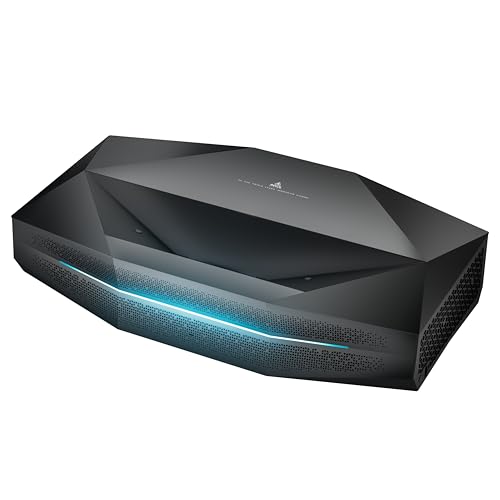
AWOL Vision built the Aetherion Pro around contrast. Its "Noirscene System II" combines a 6-level iris with an algorithm AWOL calls EBL, and the company lists up to 6,000:1 native contrast with the iris. It's an RGB triple-laser 4K projector rated at 2,600 ISO lumens with 110% Rec.2020 color, Dolby Vision, HDR10+, HDR10, HLG and dynamic tone mapping, plus Google TV.
Gamers get 1 ms ultra-low latency, VRR, ALLM and Dolby Vision Gaming per the listing. AWOL markets pixel-level clarity up to 200 inches, but at 2,600 ISO lumens, 100 to 120 inches on an ALR screen will look far better in a living room.
Pros
- Iris-assisted contrast for dark scenes
- Dolby Vision and HDR10+
- 1 ms latency, VRR, ALLM
- Google TV
Cons
- Lower brightness rating than the Epson
- Premium price tier
- 200-inch claim is optimistic for real rooms
AWOL VISION Aetherion Pro 4K UST Projector
by AWOL VISION
4. Epson Lifestudio Grand: Best Built-In Sound
Who it's for: living rooms that want great sound without adding a soundbar.
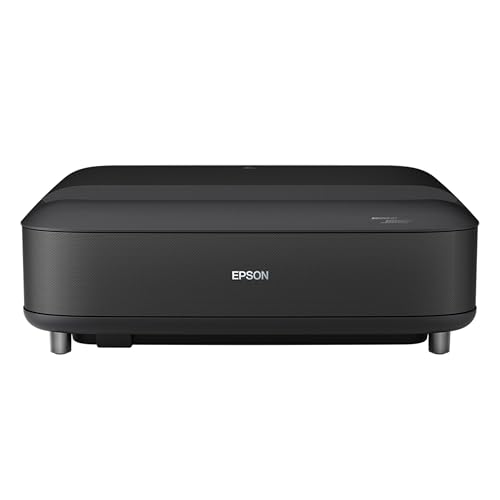
The Lifestudio Grand is Epson's newer 3LCD UST with "sound by Bose" built in. Epson rates it at 3,600 lumens of color brightness (IDMS rated) and 3,600 lumens of white brightness (ISO rated), with 4K PRO-UHD processing and HDR10. Google TV with Gemini is built in, including live TV via YouTube TV.
Epson lists pictures up to 120 inches, which suits most living rooms. If you'd rather not run a separate audio system, this is the cleanest one-box setup here.
Pros
- Bose-tuned built-in sound
- 3,600 lumens color and white
- Google TV built in
- 3LCD, no rainbow effect
Cons
- 120-inch maximum
- Pixel-shift 4K
- Premium price tier
5. Hisense PT1: Best Value Triple Laser
Who it's for: buyers who want triple-laser color and Dolby Vision for less than the PX3-PRO.
The PT1 brings Hisense's triple-laser light source to a lower tier. It's rated at 2,500 ANSI lumens with a 4K UHD picture, Dolby Vision and Dolby Atmos, IMAX Enhanced, 3D, Google TV and a 240 high refresh rate mode. Hisense lists an 80 to 150-inch range and a 25,000-hour light source life.
It's dimmer than the PX3-PRO, so keep it to 100 to 120 inches, ideally on a UST ALR screen if your room has lights on. For an evening-viewing living room, it delivers most of the Hisense experience for less.
Pros
- Triple-laser color at a lower tier
- Dolby Vision and Atmos
- Google TV and 240 refresh mode
Cons
- 2,500 ANSI lumens
- Benefits from an ALR screen
- Less premium audio than the PX3-PRO

6. Optoma ML1080UST Photon GO: Best Portable UST
Who it's for: dorm rooms, small apartments and anyone who wants a UST they can carry.
The Photon GO is a different kind of UST: a portable 1080p model with a built-in battery. Optoma says it throws a 100-inch image from less than one foot away, and lists an RGB triple-laser light source, Google TV with Google Cast and certified Netflix, 20W stereo speakers, and a TSA-compliant battery rated for up to 1.5 hours. It can also charge devices over USB-A.
At 650 ISO lumens, it's a dark-room projector, and 1.5 hours of battery won't cover most movies, so plan to plug in. But no other projector here sets up in seconds anywhere you have a wall.
Pros
- Portable, with built-in battery
- 100 inches from under 1 ft
- Google TV and Google Cast
Cons
- 650 ISO lumens
- 1.5-hour battery
- 1080p

How to choose an ultra short throw projector
The screen matters as much as the projector
UST projectors work on a white wall, but walls have bumps and texture that the steep beam exaggerates, and they reflect ceiling light straight back at you. A UST ALR screen fixes both. Pair options:
| Room | Screen type | Examples | Amazon |
|---|---|---|---|
| Living room, lights on | UST ALR / CLR, fixed frame | Elite Aeon CLR | See options |
| Can't drill, or screen must hide | Floor-rising UST ALR | Elite Kestrel CLR3, VIVIDSTORM S PRO | See options |
| Dark room | Smooth white screen listed for UST | Elite Sable Frame B2 | See options |
Never use a standard-throw ALR screen (like CineGrey 3D) with a UST. See our ALR projector screen guide, our floor-rising projector screen guide and our fixed frame projector screen picks.
Brightness and light source
Living rooms with daylight need 3,000 lumens and up, plus an ALR screen. Triple-laser projectors (Hisense, AWOL) offer the widest color; 3LCD laser projectors (Epson) avoid the rainbow effect and keep color brightness high.
Placement and size
UST throw ratios sit below about 0.4, so the projector is inches from the wall, and small moves change the image size a lot. Our throw ratio guide explains why; for UST models, always use the maker's distance chart, since some measure from the back of the unit. Check your console depth and height too: the projector needs to sit level, at the height the maker's chart specifies relative to the screen's bottom edge.
Smart platform and sound
Google TV (Hisense, AWOL, Epson Lifestudio, Optoma) and Android TV (Epson LS800) cover the main apps. Built-in audio ranges from decent to genuinely good (Epson's Yamaha and Bose systems); for movies, a soundbar or AV receiver still helps.
UST vs short throw
If your projector can sit a few feet out on a coffee table or shelf, a short throw projector often gives more brightness for the money. UST wins when the projector must sit right against the wall.
How we chose
We didn't test these projectors ourselves. We compared listings from Hisense, Epson, AWOL Vision and Optoma for light source, brightness rating, resolution, HDR support, smart platform, gaming features and audio, and looked at recurring owner feedback on picture uniformity, speckle, rainbow effect and setup. Makers rate brightness differently, so we present it as tiers and note claims that seem optimistic, such as 200-inch picture sizes.
FAQ
What is an ultra short throw projector?
An ultra short throw (UST) projector has a throw ratio below about 0.4, so it sits on a console just inches from the wall and bounces the image up onto the screen with a mirror and lens system. It replaces a TV: no ceiling mount, no long cables, and nobody walks through the beam.
Do ultra short throw projectors need a special screen?
They work on a smooth white wall, but they look much better on a screen made for them. Because the light hits at a steep upward angle, any bump or wave shows, and a UST ALR screen such as the Elite Aeon CLR rejects ceiling light so you can watch with lights on. Never use a standard-throw ALR screen with a UST.
Are UST projectors better than TVs?
They give a far bigger picture (100 to 150 inches) for the money than a TV of the same size, and they disappear when off. TVs are still brighter, better in daylight and simpler. A UST projector with an ALR screen closes much of the gap in a living room.
How far from the wall does a UST projector sit?
Usually somewhere from a few inches to around 2 ft, depending on the model and screen size. Epson's LS800 listing gives a throw distance range of about 0.9 to 2 ft, for example. Image size changes quickly with small moves, so use the maker's distance chart for your screen.
Is a UST projector worth it for gaming?
Many are. Hisense lists a 240 refresh rate mode on the PX3-PRO and PT1, and AWOL Vision lists 1 ms latency, VRR and ALLM on the Aetherion Pro. Check the input lag at the resolution and refresh rate your console uses.
Verdict
The Hisense PX3-PRO is the best ultra short throw projector for most living rooms, with triple-laser color, Dolby Vision and Google TV. Choose Epson's LS800 for the brightest picture and no rainbow effect, AWOL's Aetherion Pro for movie contrast, or the Lifestudio Grand for built-in Bose sound. Hisense's PT1 is the value triple laser, and the Optoma Photon GO is the portable outlier. Whichever you pick, budget for a UST ALR screen.