We research products independently. When you buy through links on this page, we may earn a commission from Amazon at no extra cost to you. As an Amazon Associate we earn from qualifying purchases. Read our affiliate disclosure.
A floor rising projector screen solves the hardest problem in a living room theater: where to put a big screen when the wall is a window, a bookcase, or a rental you can't drill. The case sits on the floor in front of the wall, and at the press of a button a tensioned screen rises out of it. When the movie ends, it slides back down and the room looks normal again.
Almost every floor-rising screen is built for ultra-short-throw (UST) projectors, which sit on a low console just in front of the screen. That pairing matters: the screen surface is usually a UST ambient light rejecting (ALR) material that only works with light coming steeply from below. Below are five floor-rising screens from Elite Screens and VIVIDSTORM, including one for standard projectors.
Our top picks at a glance
Quick picks
- Best Overall: Elite Screens Kestrel Tab-Tension 2 CLR3 121"Best for UST projectors in bright living rooms.
- Best 120-Inch UST Value: VIVIDSTORM S PRO 120"Best for a big UST ALR screen without wall mounting.
- Best for Smaller Rooms: VIVIDSTORM S PRO 100"Best for apartments and seating closer than 12 ft.
- Best Sound-Through Border: VIVIDSTORM S PRO P 120"Best for a center speaker or soundbar behind the lower border.
- Best for Standard-Throw Projectors: VIVIDSTORM 72" Long Throw ALRBest for a shelf or ceiling projector in a small room.
Comparison table
| Screen | Best for | Size | Surface / gain | Viewing angle | Projector type | Amazon |
|---|---|---|---|---|---|---|
| Elite Kestrel Tab-Tension 2 CLR3 | Overall | 121" 16:9 | CLR3 (ALR), 0.8 | 170° | UST only | Check price |
| VIVIDSTORM S PRO 120" | 120" value | 120" 16:9 | UST ALR, 0.6 | 170° | UST only | Check price |
| VIVIDSTORM S PRO 100" | Smaller rooms | 100" 16:9 | UST ALR, 0.6 | 170° | UST only | Check price |
| VIVIDSTORM S PRO P 120" | Speaker behind border | 120" 16:9 | UST ALR, perforated lower border | 170° | UST only | Check price |
| VIVIDSTORM Long Throw ALR 72" | Standard projectors | 72" 16:9 | Obsidian long-throw ALR, 0.8 | 150° | Standard throw only | Check price |


The best floor-rising projector screens, reviewed
1. Elite Screens Kestrel Tab-Tension 2 CLR3 121" (FTE121UH3-CLR3): Best Overall
Who it's for: living rooms where a UST projector replaces the TV and the lights are often on.
The Kestrel Tab-Tension 2 is Elite's motorized floor-rising screen, and this version uses CLR3, Elite's third-generation ceiling light rejecting material for UST projectors. Elite lists a 0.8 gain, a 170° viewing angle, rejection of up to 90% of overhead light, and support for 4K/8K and active 3D. The 121-inch, 16:9 viewing area measures 59.3 x 105.5 inches inside an overall size of 71.7 x 114.7 x 8.3 inches.
The control package is the most complete here: IR and RF remotes, a detachable wall box with a built-in IR sensor, selectable RF channels, a programmable rise position and a wired or wireless 12V trigger so the screen rises when the projector turns on. Scissor-backed risers lift the screen, and the aluminum housing is described as moisture resistant. Elite is explicit that it isn't compatible with short-throw or standard-throw projectors, and its listing also excludes "laser projectors", which conflicts with the fact that most UST projectors are lasers, so confirm compatibility for your exact projector with Elite before ordering.
Pros
- CLR3 surface rejects up to 90% of overhead light (Elite's figure)
- 170° viewing angle and 0.8 gain
- 12V trigger, programmable rise, IR and RF remotes
- Plug-and-play, no hardwiring
Cons
- UST projectors only
- Premium price tier
- Listing wording on laser compatibility needs confirming with Elite
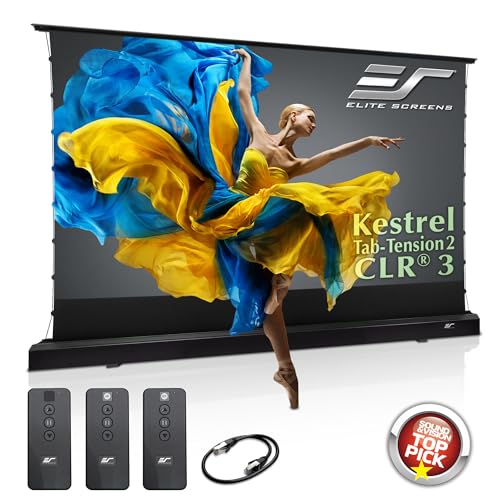
Elite Screens Kestrel Tab-Tension 2 CLR3 121-inch FTE121UH3-CLR3
by Elite Screens
2. VIVIDSTORM S PRO 120": Best 120-Inch UST Value
Who it's for: renters and living rooms with a UST laser projector that want 120 inches without drilling.
VIVIDSTORM's S PRO is a motorized, wire-tensioned floor-rising screen with a UST ambient light rejecting surface. VIVIDSTORM describes a sawtooth optical structure plus a light-suppression filter that reflects the projector's light to viewers while blocking light from above. The listing gives a 0.6 gain, a 170° viewing angle and a 120-inch, 16:9 viewing area of 104.57 x 58.82 inches, with support for 4K/8K and active 3D.
Setup is simple by design: plug in the power cord and it's ready, with no screws. VIVIDSTORM offers a 2-year manufacturer warranty. The catch is weight: the listing gives a gross weight of 72.75 lb, so it's "portable" only in the sense of moving between rooms or homes. Like every UST ALR screen, VIVIDSTORM says it doesn't work with a ceiling-mounted projector.
Pros
- 120 inches with no wall mounting
- Wire tension keeps the surface flat
- 170° viewing angle for a UST ALR
- 2-year warranty
Cons
- UST projectors only
- About 72.75 lb shipping weight
- 0.6 gain needs a reasonably bright UST

VIVIDSTORM S PRO 120-inch Portable ALR Floor Screen
by VIVIDSTORM
3. VIVIDSTORM S PRO 100" (VSDSTUST100H): Best for Smaller Rooms
Who it's for: apartments, dens and living rooms where you sit roughly 10 to 13 ft from the screen.
This is the same S PRO design and UST ALR surface (0.6 gain, 170° viewing angle) at 100 inches, with a viewing area of 87.17 x 49.02 inches. The black housing measures about 98.4 inches wide, so it fits narrower walls and consoles than the 120-inch model, and the listed gross weight drops to 61.73 lb.
A smaller screen also looks brighter with the same projector, since the light is spread over less area: a 120-inch screen has 44% more area than a 100-inch one. If you sit closer than about 12 ft, our screen size calculator will likely point you to this size anyway.
Pros
- Brighter picture than 120" with the same projector
- Narrower housing for smaller consoles
- Same tensioned UST ALR surface
Cons
- UST projectors only
- Still heavy at about 62 lb shipping weight
- Too small for long living rooms
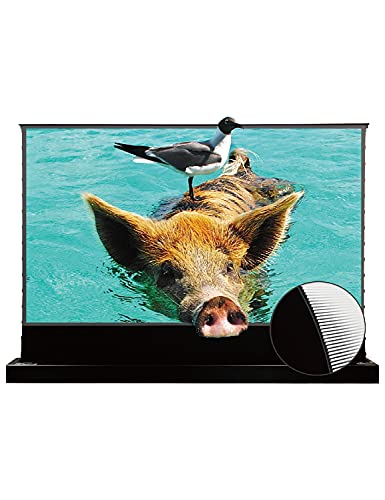
VIVIDSTORM S PRO 100-inch Floor Rising UST Screen VSDSTUST100H
by VIVIDSTORM
4. VIVIDSTORM S PRO P 120": Best Sound-Through Border
Who it's for: setups where a center speaker or soundbar sits behind the bottom of the screen.
The S PRO P adds a perforated lower black border to the 120-inch S PRO, so sound from a speaker placed behind that border passes through. The picture area itself is the same UST ALR material with a 104.57 x 58.82-inch viewing area, and VIVIDSTORM lists a 170° viewing angle. This version comes in a white housing in the listing we found.
It's a niche feature, but a useful one: floor-rising screens often end up exactly where a soundbar would sit, and the perforated border avoids blocking it. Note that only the border is perforated, not the picture area, so this isn't a fully acoustically transparent screen.
Pros
- Perforated lower border for a speaker behind
- Same tensioned UST ALR picture area
- White housing suits light rooms
Cons
- UST projectors only
- Only the border is sound-transparent
- Heaviest model here (35 kg item weight per listing)

VIVIDSTORM S PRO P 120-inch Acoustically Transparent Floor Rising Screen
by VIVIDSTORM
5. VIVIDSTORM 72" Long Throw ALR (VSDSTALR72H): Best for Standard-Throw Projectors
Who it's for: small rooms with a projector on a shelf, table or ceiling mount in front of the screen, where you still want a screen that disappears.
Most floor-rising screens are UST-only, so this one stands out. VIVIDSTORM's long-throw version uses an "Obsidian" ALR material designed for normal-throw projectors up to 2,500 ANSI lumens, and says it's not compatible with UST projectors. The listing gives a 0.8 gain, a 150° viewing angle and a 72-inch, 16:9 viewing area of 62.76 x 35.28 inches. VIVIDSTORM adds that the surface cleans with soap and water.
At 72 inches, it's a bedroom or office size; it suits seating around 7 to 10 ft away. It's the right answer for a specific problem: a hidden screen for a standard projector without any wall or ceiling installation.
Pros
- Works with standard-throw projectors
- ALR surface for rooms with some light
- No drilling, plug-in setup
Cons
- 72 inches is small for most living rooms
- Not for UST projectors
- About 53 lb shipping weight for a small screen

VIVIDSTORM 72-inch Long Throw ALR Floor Rising Screen VSDSTALR72H
by VIVIDSTORM
How to choose a floor-rising projector screen
Match the surface to your projector
This is the decision that makes or breaks a floor-rising screen.
| Your projector | Surface you need | Example | Amazon |
|---|---|---|---|
| UST on a console below the screen | UST ALR (sawtooth / CLR) | Elite Kestrel CLR3, VIVIDSTORM S PRO | See options |
| Standard throw on a shelf or ceiling | Long-throw ALR or white | VIVIDSTORM Long Throw ALR | See options |
| Short throw on a table | Check the listing; most UST ALR surfaces won't work | Ask the maker |
A UST ALR surface paired with a ceiling projector looks dim and uneven, and the reverse is just as bad. Our ALR projector screen guide explains why the angle of light matters so much. If you haven't bought the projector yet, start with our ultra short throw projector guide.
Size: UST placement is precise
UST projectors change image size dramatically with small changes in distance from the screen, because their throw ratios are tiny (well below 0.4). Check the projector maker's distance chart for your target size before you buy the screen, and our throw ratio guide explains the math. Then pick the screen size with seating distance in mind: 100 inches suits roughly 10 to 13.6 ft, 120 inches roughly 12 to 16 ft.
Housing depth and console layout
The screen case sits on the floor behind or beside the console, and the UST projector sits in front of it. Measure the full depth you'll need (case plus gap plus projector plus console), and check the case width: it's wider than the picture. Elite lists 8.3 inches of depth for the Kestrel CLR3 case.
Tension and flatness
UST projectors exaggerate any ripple, because light hits the surface at a steep angle. Floor-rising screens use tab tension (Elite) or wire tension (VIVIDSTORM) to keep the surface flat. Avoid untensioned pull-up screens with a UST projector.
Control and power
You'll need an outlet near the case. A 12V trigger, which Elite lists for the Kestrel, raises the screen when the projector powers on. RF remotes don't need line of sight, which helps when the case is behind a console.
Floor-rising vs fixed frame
If you own the wall and it can hold a permanent screen, a fixed frame projector screen like the Elite Aeon CLR gives the same UST ALR performance for less money and no motor. Choose floor-rising when the screen must hide or the wall can't be used.
How we chose
We didn't install these screens ourselves. We compared Elite Screens and VIVIDSTORM listings for surface type, gain, viewing angle, tensioning, projector compatibility, controls, size and weight, and looked at recurring owner feedback about flatness, motor noise and setup. We only quote specs from the listings, and we flag wording that looks contradictory, such as the Kestrel listing's note on laser projectors.
FAQ
What is a floor rising projector screen?
It is a motorized screen whose case sits on the floor or a low console, with the screen rising up out of it on scissor or tension arms when you press a button. It needs no wall or ceiling mounting, so it suits renters, rooms with windows behind the screen and living rooms where a UST projector sits on a console in front of it.
Do floor rising screens work with ultra short throw projectors?
Most of them are designed for exactly that. Elite's Kestrel CLR3 and VIVIDSTORM's S PRO use UST ambient light rejecting surfaces that only work with a UST projector placed below the screen. If you use a ceiling or shelf projector, choose a floor-rising screen with a long-throw surface, such as VIVIDSTORM's long-throw ALR model.
Are floor rising projector screens worth it?
They are worth it when you can't or don't want to drill into the wall, or when the screen has to disappear in a living room. They cost more than fixed frame screens of the same size, are heavy, and need a power outlet, so if the wall can hold a permanent screen, a fixed frame gives the same flatness for less.
How heavy is a floor rising projector screen?
Heavy. VIVIDSTORM lists a gross weight of about 72.75 lb for its 120-inch S PRO and about 61.73 lb for the 100-inch version, so plan for two people to unbox and position one.
Do floor rising screens need to be plugged in?
Yes. They are motorized, so they need a standard outlet near the case. Elite's Kestrel is plug-and-play with no hardwiring, and both brands offer remotes; Elite also lists a 12V trigger so the screen can rise when the projector turns on.
Verdict
The Elite Screens Kestrel Tab-Tension 2 CLR3 is the best floor rising projector screen for a UST projector in a bright living room, with the most complete controls. VIVIDSTORM's S PRO delivers the same idea at 100 or 120 inches with fewer frills, and the S PRO P adds a sound-through border. If your projector sits on a shelf or ceiling, VIVIDSTORM's long-throw ALR model is the rare floor-rising screen built for it.