We research products independently. When you buy through links on this page, we may earn a commission from Amazon at no extra cost to you. As an Amazon Associate we earn from qualifying purchases. Read our affiliate disclosure.
A good projector screen does three things a wall can't: it gives you a perfectly uniform surface, a controlled gain, and a black border that frames the picture. The right projector screen depends far more on your room than on the brand. A dark basement theater, a bright living room and a backyard all call for different surfaces and different formats.
Before anything else, decide two things: how much light your room has, and what kind of projector you own. A standard-throw projector on the ceiling works with almost any white screen. An ultra-short-throw (UST) projector on a console needs a screen made for it, or you'll waste its potential. If you're buying both at once, our matched projector and screen pairs take the guesswork out. Below are seven picks covering every common setup, all from established screen makers. For dealer-grade brands, see our Da-Lite and Draper comparison.
Our top picks at a glance
Quick picks
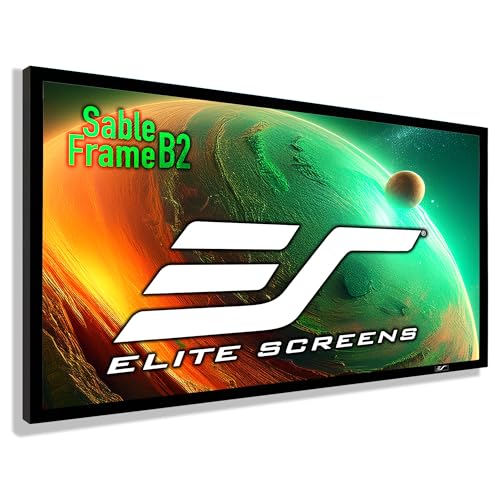
- Best Overall: Elite Screens Sable Frame B2 120" (SB120WH2)Best for dark home theaters and any projector type.
- Best Value: Silver Ticket STR-169120Best for a full 120-inch fixed frame on a tighter budget.
- Best ALR for UST Projectors: Elite Screens Aeon CLR 123" (AR123H-CLR)Best for living rooms with an ultra-short-throw projector.
- Best for Rooms with Some Light: Elite Screens Sable Frame CineGrey 3D 120"Best for ceiling-mounted projectors in rooms you can't fully darken.
- Best Motorized: Elite Screens Spectrum 2 100" (SPM100H-E12)Best for a screen that disappears into the ceiling at the press of a button.
- Best Budget Pull-Down: Elite Screens Manual 100" (M100UWH)Best for a first screen in a multi-use room.
- Best Outdoor: Elite Screens Yard Master 2 125" (OMS125H2)Best for backyard movie nights on a rigid frame.
Comparison table
| Screen | Best for | Type | Size / format | Surface / gain | Projector type | Amazon |
|---|---|---|---|---|---|---|
| Elite Screens Sable Frame B2 SB120WH2 | Dark home theater | Fixed frame | 120" 16:9 | CineWhite UHD-B, 1.3 | Standard, short, UST | Check price |
| Silver Ticket STR-169120 | Value fixed frame | Fixed frame | 120" 16:9 | White, 1.1 | Standard | Check price |
| Elite Screens Aeon CLR AR123H-CLR | Bright living room | Fixed frame, edge-free | 123" 16:9 | CLR (ALR), 0.6 | UST only | Check price |
| Elite Screens CineGrey 3D ER120DHD3 | Some ambient light | Fixed frame | 120" 16:9 | CineGrey 3D, 1.2 | Standard throw only | Check price |
| Elite Screens Spectrum 2 SPM100H-E12 | Hidden when not in use | Motorized | 100" 16:9 | MaxWhite FG | Standard | Check price |
| Elite Screens Manual M100UWH | Budget, multi-use rooms | Manual pull-down | 100" 16:9 | White | Standard (not short/UST) | Check price |
| Elite Screens Yard Master 2 OMS125H2 | Backyard | Portable frame with stand | 125" 16:9 | CineWhite UHD-B, 1.3 | Standard | Check price |




The best projector screens, reviewed
1. Elite Screens Sable Frame B2 120" (SB120WH2): Best Overall
Who it's for: anyone building a dedicated theater or media room where you can control the lights.
The Sable Frame B2 is the screen we'd point most people to first. Elite lists it with ISF-certified CineWhite UHD-B material at 1.3 gain and a 180° viewing angle, so everyone on a wide sofa sees the same brightness. The material is black-backed, which stops light from bleeding through. It's rated for 4K/8K, HDR and active 3D, and the listing states it works with standard, short and ultra-short-throw projectors, which is rare for a white screen.
The frame is velvet-wrapped aluminum, and the wall brackets let the screen slide sideways after you hang it, so you can center it without re-drilling. The 120-inch version has a viewing area of about 104.7 x 58.7 inches. Elite backs US purchases with a 2-year warranty.
Pros
- 1.3 gain and a 180° viewing angle: bright and even from every seat
- Compatible with standard, short and UST projectors
- Sliding brackets make centering easy
- Black-backed to stop light bleed
Cons
- A white surface washes out in bright rooms
- Fixed frames need a permanent wall spot
- Two people needed to assemble and hang the frame
2. Silver Ticket STR-169120: Best Value
Who it's for: buyers who want a real tensioned fixed frame at 120 inches without paying premium-brand prices.
Silver Ticket's STR series is a long-running favorite for first home theaters. The STR-169120 is a 120-inch, 16:9 screen with a white 1.1 gain surface, stretched over a 6-piece aluminum frame. The overall size is listed at 109.25 x 63.625 inches, so measure your wall with the frame included. Silver Ticket's listing gives a 160° viewing angle.
A 1.1 gain white surface is close to neutral, which means accurate color and a forgiving viewing cone. The frame comes in pieces, so you'll be snapping the material onto it with springs or tabs on the floor before hanging. Silver Ticket also sells the same frame with a high-contrast grey surface (STR-169120-HC), which is worth a look if your room isn't fully dark.
Pros
- Full 120-inch fixed frame at a mid-range price
- Near-neutral 1.1 gain white surface
- 6-piece aluminum frame ships in a manageable box
- Grey variant available for rooms with some light
Cons
- Assembly takes time and floor space
- Fewer published specs than Elite's listings
- Not marketed for short or UST projectors

Silver Ticket STR-169120 120-inch Fixed Frame Screen
by Silver Ticket
3. Elite Screens Aeon CLR 123" (AR123H-CLR): Best ALR for UST Projectors
Who it's for: living rooms with windows and overhead lights, paired with an ultra-short-throw projector.
UST projectors sit inches from the wall and fire light steeply upward. The Aeon CLR is built for exactly that angle. Elite describes its ceiling light rejecting material as rejecting up to 95% of overhead light, with a 0.6 gain and a 180° viewing angle, in an edge-free frame that looks more like a big TV than a theater screen.
The catch is equally clear: the listing says it's exclusively for UST projectors. Put a ceiling-mounted projector in front of it and the picture will look dim and uneven. If you own a UST and want to watch with the lights on, this is the kind of screen that makes it work; check your projector's distance chart for 123 inches before you order. Our ALR projector screen guide compares it to other ambient light rejecting options.
Pros
- Strong rejection of overhead light for daytime viewing
- Edge-free frame looks sleek in a living room
- 180° viewing angle despite the low gain
Cons
- UST projectors only
- Premium price tier
- 0.6 gain needs a bright projector

Elite Screens Aeon CLR 123-inch AR123H-CLR
by Elite Screens
4. Elite Screens Sable Frame CineGrey 3D 120" (ER120DHD3): Best for Rooms with Some Light
Who it's for: owners of a ceiling- or shelf-mounted standard-throw projector in a room that's never fully dark.
CineGrey 3D is Elite's ambient light rejecting material for normal projectors. The listing gives a 1.2 gain, a 90° viewing angle and a claimed 65% rejection of ceiling light. In practice, a grey ALR surface keeps blacks from turning milky when a lamp is on, while the 1.2 gain recovers some of the brightness a grey surface normally loses.
Two trade-offs to know. First, a 90° viewing angle is narrower than a white screen's, so very wide seating rows will see some falloff at the ends. Second, Elite states it's for standard-throw projectors only, not short-throw, UST or triple-laser models. The frame is a 2.36-inch black velvet border, and the viewing area is about 104.7 x 58.9 inches.
Pros
- Deeper blacks with lamps or daylight around
- 1.2 gain offsets some of the grey brightness loss
- Same easy fixed-frame install
Cons
- Standard-throw projectors only
- Narrower 90° viewing angle
- Not ideal for very wide seating

Elite Screens Sable Frame CineGrey 3D 120-inch ER120DHD3
by Elite Screens
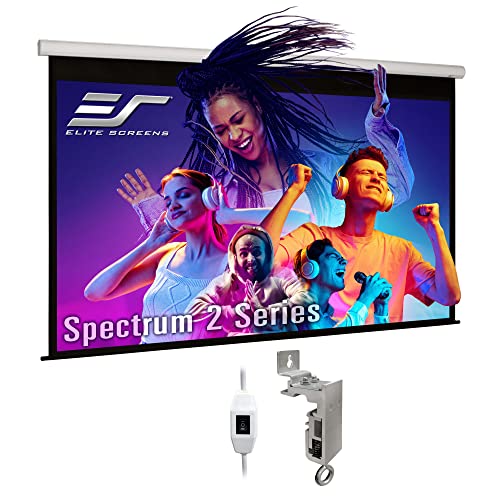
5. Elite Screens Spectrum 2 100" (SPM100H-E12): Best Motorized
Who it's for: living rooms and bonus rooms where the screen should vanish when the TV is on.
The Spectrum 2 is a 100-inch, 16:9 electric drop-down screen with a 12-inch top drop, which lowers the picture below the case so it lines up with your projector instead of crowding the ceiling. The surface is Elite's MaxWhite FG. It's a plain-vanilla motorized screen from a mainstream brand, and that's the point: a simple, dependable way to get a big image without a permanent frame on the wall.
Remember that motorized screens need power where the case mounts, and that non-tensioned roll-down fabric can show slight edge waves over time. If perfect flatness matters, see the tab-tensioned picks in our motorized projector screen guide.
Pros
- Retracts out of sight at the press of a button
- 12-inch drop helps align the image with the projector
- Mainstream brand with US support
Cons
- Needs an outlet near the mounting point
- Not tab-tensioned, so edges can wave slightly
- 100 inches is the size listed here; larger sizes cost more
6. Elite Screens Manual 100" (M100UWH): Best Budget Pull-Down
Who it's for: first-time projector owners, kids' rooms, offices and any room where a screen should roll away.
The M100UWH is the budget workhorse of Elite's lineup: a 100-inch, 16:9 manual pull-down with an auto-lock that holds the screen at your chosen height. The listing says it can be installed on a wall or hung from a suspended ceiling. Elite also states it's not compatible with short-throw or ultra-short-throw projectors, so pair it with a standard ceiling or tabletop projector.
You're not getting tensioned flatness at this price, and pull-down screens can develop a slight curl at the edges over years of use. But for a fraction of a fixed frame's cost, it gives you a clean, uniform white surface that beats a painted wall. Pull-down models with slow retract cost a little more and are worth it at larger sizes.
Pros
- Budget-friendly 100-inch 16:9 screen
- Wall or ceiling mounting
- Auto-lock holds any height
Cons
- Not for short-throw or UST projectors
- No slow-retract mechanism on this model
- Edges can curl over time

7. Elite Screens Yard Master 2 125" (OMS125H2): Best Outdoor
Who it's for: families who want a sturdy, flat backyard screen that sets up in minutes.
The Yard Master 2 uses the same CineWhite UHD-B material as Elite's indoor screens (1.3 gain, 180° viewing angle), snapped onto a tool-free aluminum frame with legs. Check the listing for the carry bag and anchoring accessories included with the size you order. Because the material is stretched on a frame, it stays flatter than hanging fabric screens, and it doesn't need a blower like an inflatable.
Elite is upfront that it's only mildly weather resistant. Store it indoors between uses, and don't leave it out in the elements. For more backyard options, from inflatables to 150-inch screens, see our outdoor projector screen guide.
Pros
- Rigid frame keeps the surface flat
- Same 1.3 gain material as Elite's indoor screens
- Tool-free setup
Cons
- Not meant to stay outside
- Wind can still push a large frame around
- Bulkier to transport than fabric screens

How to choose a projector screen
Start with your room's light
Light control matters more than any spec on the box. In a dark room, a matte white screen at 1.0 to 1.3 gain gives the brightest, most accurate image. In a room with windows or lamps you'll keep on, a grey or ALR surface holds onto contrast. The cost is brightness and, often, viewing angle. Our grey vs white projector screen guide walks through that decision.
Match the screen to your projector type
This is where most buyers go wrong.
- Standard-throw projectors (ceiling, shelf or table, several feet back) work with almost any screen, including standard-throw ALR surfaces like CineGrey 3D.
- Short-throw projectors need a screen the maker lists as short-throw compatible. Some textured or angular materials produce hot spots at steep angles.
- Ultra-short-throw projectors need either a smooth white screen rated for UST (like the Sable Frame B2) or a dedicated UST ALR screen (like the Aeon CLR). A UST ALR screen does not work with a ceiling projector.
Pick the right size
Bigger isn't always better. SMPTE recommends that a screen fill at least 30° of your field of view, and THX recommends about 36° to 40° for an immersive seat. At a 10-foot seating distance, that's roughly a 74-inch to 100-inch 16:9 screen. Use our projector screen size calculator to run your own numbers, and check that your projector can actually throw that size from where it sits.
| Size (16:9) | Viewing width | Viewing height | Amazon |
|---|---|---|---|
| 100" | 87.2" | 49.0" | See options |
| 120" | 104.6" | 58.8" | See options |
| 150" | 130.7" | 73.5" | See options |
Choose the format: fixed, motorized, pull-down or portable
- Fixed frame: the flattest surface and best picture, but permanently on the wall. See our fixed frame projector screen picks.
- Motorized: hides away, with a remote. Needs power and costs more. Tab-tensioned models stay flatter.
- Manual pull-down: cheapest way to get a retractable screen. Look for slow-retract on bigger sizes.
- Portable and outdoor: tripod, folding-frame or inflatable. Great flexibility, less flatness than a fixed frame.
Gain and viewing angle
Gain describes how much light a screen reflects straight back compared with a reference white surface (1.0). Higher gain looks brighter on-axis but can narrow the viewing angle and create hot spots. For most homes, 1.0 to 1.3 is the sweet spot. Very low-gain ALR surfaces (0.6 or so) rely on a bright projector.
Is a screen worth it over a wall?
Usually, yes. A real screen has a smooth, color-neutral surface and black borders that improve perceived contrast. A painted wall can work for casual use, though. Our projector screen vs wall guide explains when you can skip the screen.
How we chose
We didn't test these screens in person. We built the list from research: manufacturer and retailer specifications from Elite Screens and Silver Ticket, viewing-angle guidance from SMPTE and THX, and recurring patterns in owner feedback such as flatness, edge waves and assembly time. We prioritized surface specs (gain, viewing angle, backing), compatibility with each projector type, frame or mechanism quality and warranty. We left out any spec we couldn't confirm from the maker or a retailer listing.
FAQ
What is the best projector screen for a home theater?
For a dedicated, dark room, a fixed frame screen with a matte white surface around 1.0 to 1.3 gain is the safest choice. The Elite Screens Sable Frame B2 (CineWhite UHD-B, 1.3 gain, 180-degree viewing angle) is our top pick because it works with standard, short and ultra-short throw projectors.
Is a grey or white projector screen better?
White is better in a dark room because it reflects the most light. Grey or ALR screens help when you can't control ambient light, because they deepen blacks, but they need a brighter projector. Our grey vs white guide covers the trade-off in detail.
What size projector screen should I buy?
Size it to your seating distance. SMPTE recommends that the screen fill at least 30 degrees of your field of view and THX recommends about 36 to 40 degrees. At 10 ft from the screen, that works out to roughly 74 to 100 inches diagonal for a 16:9 screen.
Are cheap projector screens worth it?
A budget pull-down or fabric screen is still a clear upgrade over most walls, because the surface is uniform and the borders frame the image. Where cheap screens fall short is flatness: thin fabric and roll-up screens can wave or curl at the edges, which fixed frame and tab-tensioned screens avoid.
Can I use an ALR screen with any projector?
No. Ultra-short-throw ALR screens such as the Elite Screens Aeon CLR are designed only for UST projectors placed below the screen. Standard-throw ALR or grey screens, such as CineGrey 3D, are designed for ceiling- or shelf-mounted projectors. Check the listing before you buy.
Verdict
For most dark home theaters, the Elite Screens Sable Frame B2 is the best projector screen: bright, even, and compatible with every projector type. If budget is tight, the Silver Ticket STR-169120 gets you a real 120-inch fixed frame for less. Fighting daylight with a UST projector? The Elite Aeon CLR is the specialist. And if the screen needs to move outdoors, start with the Yard Master 2.