We research products independently. When you buy through links on this page, we may earn a commission from Amazon at no extra cost to you. As an Amazon Associate we earn from qualifying purchases. Read our affiliate disclosure.
A portable projector screen earns its keep by going up fast, staying put and packing away small. That's true whether you're pitching to a client, setting up a kids' movie in the basement or taking a projector camping. The best portable projector screen for you depends mostly on where it'll live: indoors on a hard floor, or outside on grass.
There are two main designs. Tripod pull-up screens roll out of a case and hook onto a pole, like a classroom screen. For dedicated school picks, see our projector screens for schools. They're quick and tidy, with a tensioned roll surface, but usually top out around 100 inches. Fabric screens on folding stands go much bigger (120 to 150 inches), weigh little, and often support rear projection, but they're more prone to wrinkles and wind. Here are seven picks across both.
Our top picks at a glance

Quick picks
- Best Overall: Elite Screens Tripod 100" (T100UWH)Best for indoor movies, classrooms and presentations.
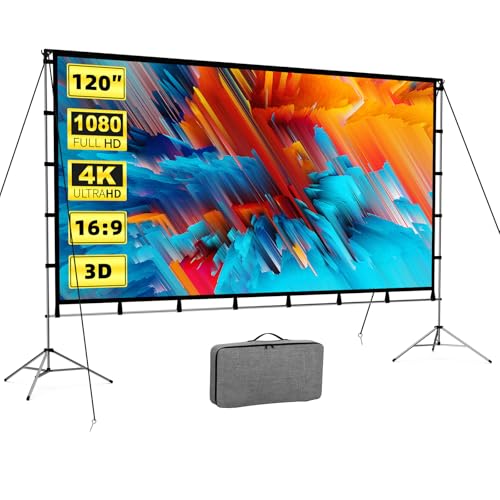
- Best Value: Vamvo 120" with StandBest for a light, cheap backyard screen with front and rear projection.
- Best 150-Inch with Stand: ACSTAB 150"Best for bigger groups who want a stand screen.
- Best 150-Inch Alternative: STWUI 150" with StandBest for a second 150-inch stand screen option.
- Best Weighted-Base Stand: STWUI 120" with StandBest for a 120-inch stand screen that sits on a flat base instead of legs.
- Best 2-in-1 Tripod or Wall: Elite Screens Yard Master Sport 110"Best for switching between a stand and wall hanging.
- Best Portable ALR (UST): VIVIDSTORM S PRO 120"Best for a floor-standing ALR screen with an ultra-short-throw projector.
Comparison table
| Screen | Best for | Design | Size / format | Surface | Rear projection | Amazon |
|---|---|---|---|---|---|---|
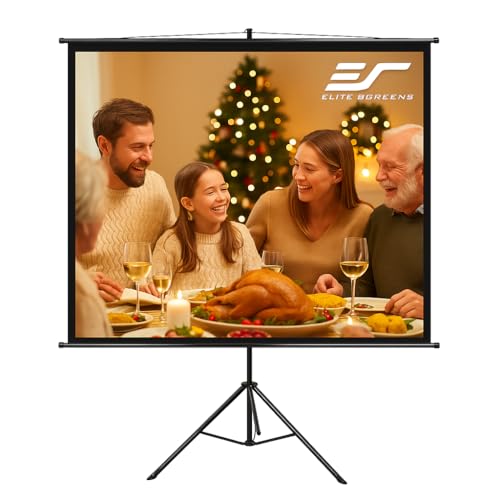
| Elite Screens Tripod T100UWH | Indoor, presentations | Tripod pull-up | 100" 16:9 | MaxWhite 2, 1.1 gain, 180° | No | Check price |
| Vamvo 120" with Stand | Value | Fabric on aluminum stand | 120" 16:9 | Polyester | Yes | Check price |
| ACSTAB 150" with Stand | Big groups | Fabric on 35" tripod stand | 150" 16:9 | Milk silk, 160° | Yes (per listing) | Check price |
| STWUI 150" with Stand | 150" alternative | Fabric on 35" tripod stand | 150" 16:9 | Milk silk, 160° | Yes (per listing) | Check price |
| STWUI 120" with Stand | Weighted base | Fabric on weighted-base stand | 120" 16:9 | Milk silk, 160° | Yes (per listing) | Check price |
| Elite Yard Master Sport 110" | Stand or wall | Tripod or wall hanging | 110" 4:3 | MaxWhite, 1.1 gain, 180° | No | See options |
| VIVIDSTORM S PRO 120" | UST in bright rooms | Motorized floor-rising screen | 120" 16:9 | ALR | No | Check price |



The best portable projector screens, reviewed
1. Elite Screens Tripod 100" (T100UWH): Best Overall
Who it's for: anyone who needs a screen to appear and disappear indoors: home movie nights in a shared room, classrooms, offices and trade shows.
The Tripod series is one of Elite's longest-running products, and the T100UWH is the 16:9 home-theater size. The surface is MaxWhite 2 with 1.1 gain and a 180° viewing angle, rolled into a case on a tripod base. You pull the screen up, hook it to the pole and adjust the height. Elite lists the viewing area at 49.0 x 87.2 inches and the item weight at 18.9 pounds, with a 2-year warranty.
Elite states it isn't compatible with short-throw or ultra-short-throw projectors, so pair it with a standard projector on a table or stand. The listing calls it suitable for indoor and outdoor use, but a tripod screen is happiest on a hard, level floor; on grass or in wind, a stand screen with stakes is steadier.
Pros
- Sets up and retracts in about a minute
- 1.1 gain, 180° viewing angle surface
- Self-contained: the case protects the screen
- 2-year warranty from a major screen brand
Cons
- Not for short-throw or UST projectors
- 100 inches is modest for a backyard
- Tripod base is less stable outdoors
2. Vamvo 120" Projector Screen with Stand: Best Value
Who it's for: casual movie nights, camping trips and anyone who wants a big screen without a big bill.
Vamvo's 120-inch screen pairs a 16:9 fabric surface with a folding aluminum alloy stand. The listing includes nine grounding spikes and wind ropes, supports front and rear projection, and quotes a setup time of about two minutes. At about 7 pounds, it's far lighter than a tripod pull-up screen.
The trade-off is flatness: fabric stretched on a stand won't be as perfectly smooth as a roll-up tripod screen, and fold lines take some time to relax. For outdoor movie nights where the picture is 120 inches and the audience is on blankets, that's rarely a problem.
Pros
- 120 inches for a low price tier
- Front and rear projection
- Stakes and ropes included
- Very light to carry
Cons
- Fabric can show fold lines
- Less rigid than tripod or snap-frame designs
- Fewer published specs than big-brand screens
3. ACSTAB 150" Outdoor Projector Screen with Stand: Best 150-Inch with Stand
Who it's for: larger families and groups who want a 150-inch stand screen they can carry.
ACSTAB's 150-inch screen is a 16:9 washable "milk silk" fabric on a floor-standing frame with a tripod base, sold with a 35 x 5 inch carry bag. ACSTAB says it upgraded the tripod and accessories specifically to fix the instability older stand screens had: 35-inch legs with 1.2-inch tubes, plus dedicated ground stakes that work with wind ropes. The listing gives a 160° viewing angle and front and rear projection, and the listed product dimensions are 133 x 102 inches.
At 150 inches, brightness becomes the limiting factor. A 150-inch picture covers about 56% more area than 120 inches, so pair it with a bright projector and start after dark. ACSTAB is a newer brand than Elite, and its listings aren't consistent on some details such as weight, so we'd treat it as a size-for-money pick and stake it down carefully.
Pros
- 150-inch picture on a portable stand
- Upgraded tripod base with stakes and wind ropes
- Carry bag included
Cons
- Needs a bright projector
- Inconsistent specs across listings
- Large fabric area is wind-sensitive

ACSTAB 150-inch Outdoor Projector Screen with Stand
by ACSTAB
4. STWUI 150" Projector Screen with Stand: Best 150-Inch Alternative
Who it's for: anyone who wants a 150-inch picture that still fits in a carry bag, and would rather buy from a seller with a longer run of stand screens.
STWUI describes a 35-inch tripod with wind ropes and ground stakes, a foldable and washable "milk silk" fabric in 16:9 with a 160° viewing angle, front and rear projection, tool-free assembly and a 35 x 5 inch carry bag. The listed product dimensions are 133 x 102 inches, the same as the ACSTAB above, and the two listings describe near-identical hardware.
So treat them as alternatives and pick on availability and the seller's support terms. Everything we said about brightness at 150 inches applies here too. If you have a bright projector and a dark yard, it's an affordable way to get a near-cinema-size picture. Use every stake and rope, because a 150-inch fabric screen catches a lot of wind.
Pros
- 150-inch picture on a portable stand
- Tool-free setup, stakes and ropes included
- Compact 35-inch carry bag
Cons
- Needs a bright projector and full darkness
- Fabric needs time under tension to lose creases
- Wind-sensitive at this size

5. STWUI 120" Outdoor Projector Screen with Stand: Best Weighted-Base Stand
Who it's for: patios, decks and indoor rooms where a flat base is easier to place than splayed tripod legs, and 120 inches is plenty.
STWUI's 120-inch screen uses a 16:9 "milk silk" fabric that STWUI describes as elastic, foldable and washable, mounted on a frame that stands on a chassis base rather than a tripod. STWUI says it lengthened and weighted the chassis to stop wobbling and added two holes for ground nails. The listing also gives a 160° viewing angle, front and rear projection, an all-metal bracket with a removable beam that assembles without tools, and about nine minutes of setup. The listed product dimensions are 108 x 78.5 inches, and everything packs into a 7.8 x 17.7 inch storage bag.
At 120 inches, it's a far easier screen to light than the 150-inch models above, so mid-brightness home projectors and brighter portables work well after dark. Compared with the Vamvo and its nine ground spikes, you trade a staked stand for a weighted base, which suits hard surfaces better than open lawns. Like every fabric stand screen, it needs calm weather outdoors and time under tension for fold lines to relax.
Pros
- Flat base suits decks and indoor floors
- 120 inches is easy to fill with most projectors
- Small storage bag
Cons
- Fewer anchor points than the roped 150-inch tripods
- Fabric shows fold lines at first
- Fewer published surface specs than Elite
STWUI 120-inch Outdoor Projector Screen with Stand
by STWUI
6. Elite Screens Yard Master Sport 110": Best 2-in-1 Tripod or Wall
Who it's for: people who want one screen for both a stand setup and hanging on a wall or fence.
The Yard Master Sport combines a tripod stand with a wall-hanging option, so you can use it in the yard one weekend and hang it in a garage or basement the next. Elite lists MaxWhite material with 1.1 gain and a 180° viewing angle, plus a carry bag. Note that this 110-inch version is 4:3, so a widescreen movie will have black bars at the top and bottom.
If you mostly watch movies, the 4:3 shape is a compromise: a 110-inch 4:3 screen is 88 x 66 inches, so a 16:9 movie filling its width is about 88 x 49.5 inches, the same as a roughly 101-inch 16:9 screen. It shines for mixed use (presentations, sports, kids' content) where flexibility matters more than the cinema shape.
Pros
- Stand or wall mounting
- 1.1 gain, 180° MaxWhite surface
- Carry bag included
Cons
- 4:3 format leaves letterbox bars on movies
- Front projection only
- Smaller usable widescreen area than its diagonal suggests
Elite Screens Yard Master Sport 110-inch
by Elite Screens
Currently unavailable on Amazon
7. VIVIDSTORM S PRO 120" Portable ALR Floor Screen: Best Portable ALR (UST)
Who it's for: renters and living rooms with an ultra-short-throw projector, where you can't or won't mount a screen on the wall.
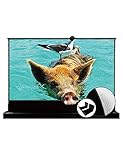
VIVIDSTORM's S PRO is a motorized, tensioned floor-rising screen with an ambient light rejecting surface, designed for UST laser projectors: the screen rises out of a base that sits on the floor or a console and retracts into it when you're done. It's "portable" only in the sense that it needs no wall mounting and moves with you between homes; it needs a power outlet and isn't for outdoor or camping use. VIVIDSTORM lists it for indoor use and 4K, 3D and HD UST projectors.
As with every UST ALR screen, it only works properly with a UST projector placed below the screen. It's also a premium-tier product compared with fabric stand screens. Our ALR projector screen guide explains how these surfaces reject ceiling light.
Pros
- ALR surface for watching with lights on
- Tensioned for a flat picture
- No wall mounting required; retracts into its base
Cons
- UST projectors only
- Indoor use, needs an outlet
- Premium price tier

VIVIDSTORM S PRO 120-inch Portable ALR Floor Screen
by VIVIDSTORM
How to choose a portable projector screen
Tripod pull-up vs fabric on a stand
| Tripod pull-up | Fabric on stand | |
|---|---|---|
| Typical sizes | 60–100" (some larger) | 100–150" |
| Flatness | Good, rolled and tensioned | Fair to good, depends on stretch |
| Setup | About a minute | A few minutes, tool-free |
| Weight | Heavier (Elite T100UWH: 18.9 lb) | Lighter (Vamvo: about 7 lb) |
| Rear projection | Rarely | Often |
| Best place | Hard floors indoors | Grass and outdoors |
| Amazon | See options | See options |
Size: be honest about brightness
Bigger portable screens are cheap, but brightness isn't. A 120-inch 16:9 screen is about 105 x 59 inches; a 150-inch is about 131 x 74 inches. If your projector is a small battery model, 100 to 120 inches will look much better than 150. Our 100, 120 and 150-inch screen guide covers each size in detail, and the screen size calculator matches the screen to your seating distance.
Aspect ratio
Choose 16:9 for movies, TV and streaming. 4:3 or 1:1 screens suit presentations and mixed use but waste space with widescreen video. A few tripod screens can be pulled to different heights for multiple ratios.
Projector compatibility
Most portable screens are designed for standard-throw projectors. Elite says the Tripod T100UWH isn't for short-throw or UST projectors. The reverse is also true: UST ALR screens like the VIVIDSTORM S PRO only work with UST projectors.
Stability outdoors
Look for ground stakes, wind ropes and a wide base. ACSTAB and STWUI both call out reinforced tripod bases on their 150-inch screens and weighted chassis bases on their smaller ones. Even so, any screen over 100 inches is a sail: calm nights only, and stake everything. Our outdoor projector screen guide covers framed screens that handle breezes better.
Packing and care
Check the folded size and whether the case is padded. Fabric screens should go away dry, and folding them along the same lines each time keeps creases predictable. Tripod screens should be retracted slowly so the surface rolls evenly.
How we chose
We didn't handle these screens ourselves. We researched manufacturer and retailer listings from Elite Screens, VIVIDSTORM, Vamvo, ACSTAB and STWUI, focusing on surface specs, size and format, setup design, stability features and projector compatibility. We also looked at owner feedback patterns, such as fold lines on fabric screens and stability on grass. Specs come only from the makers' or retailers' listings, and we note where those listings disagree.
FAQ
What is the best portable projector screen?
For indoor use and presentations, a pull-up tripod screen such as the Elite Screens Tripod T100UWH is the most practical: it sets up in a minute and retracts into its case. For backyards, a fabric screen on a folding stand, such as the Vamvo 120-inch, is lighter and bigger.
Is a projector screen with stand stable outdoors?
Reasonably, if you use the included stakes and ropes and avoid wind. Stand screens are lightweight by design, so they move in gusts. ACSTAB and STWUI both list upgraded tripod bases with ground stakes and wind ropes on their 150-inch screens, and weighted bases with ground-nail holes on their smaller ones.
What size portable projector screen should I get?
100 inches suits rooms and small groups, 120 inches is the backyard sweet spot, and 150 inches and up is for larger groups with a bright projector. Use your seating distance: at about 10 ft, 74 to 100 inches fills the SMPTE to THX viewing-angle range.
Can a portable screen be used for rear projection?
Many fabric stand screens can. Vamvo lists front and rear projection on its aluminum-stand screen, and ACSTAB and STWUI listings describe the same. Tripod pull-up screens like the Elite Tripod are front projection only.
How do you get wrinkles out of a portable projector screen?
Set it up on its stand and leave it under tension for several hours, which relaxes most fold lines. Some makers allow washing or low heat, but follow the care instructions on your model, because heat can damage some coatings.
Verdict
For most indoor uses, the Elite Screens Tripod T100UWH is the best portable projector screen: fast, tidy and backed by a known brand. For backyards, the Vamvo 120-inch with stand is the value pick, STWUI's 120-inch suits decks and patios with its flat base, and the ACSTAB or STWUI 150-inch screens get you a much bigger picture if your projector is bright enough. Running a UST in a bright living room? The VIVIDSTORM S PRO is the portable ALR answer.